
AJ POWER · MEDICAL & MOBILITY
Medical
battery packs.
Built for mobility.
Custom medical battery packs for stairlifts, medical carts, powered wheelchairs and patient lifts. Engineered around your equipment, charging routine and power requirements.
- Device fit
- Housing & connectors
- Smart BMS
- Protection & integration
- OEM review
- Requirements to validation

01 / APPLICATIONS
Different devices.
Different power demands.
Start with how the equipment is used. Motor peaks, time on charge, available space and service access shape the battery brief.

STAIRLIFTS & CHAIRLIFTS
Short journeys.
Long periods on standby.
Stairlift battery packs need to be specified around the motor load, charging dock and the space available within the carriage.
- Motor starting and peak-current requirements
- Charging contact arrangement and standby routine
- Installation envelope, servicing and replacement access

MEDICAL CARTS & WORKSTATIONS
Power matched
to a mobile workflow.
Medical cart battery packs start with the connected equipment and the way the workstation moves between charging opportunities.
- Continuous load, required runtime and output interfaces
- Adapter-to-battery transition and charging access
- Serviceable enclosure, docking or hot-swap requirements

POWERED WHEELCHAIRS & PATIENT LIFTS
Motion loads.
Equipment-specific integration.
Wheelchair and patient-lift battery packs require a clear understanding of the motor controller, duty cycle and mechanical installation.
- Start-up peaks, load duration and usable energy
- Battery restraint, connector fit and charging interface
- Storage routine, maintenance and replacement planning
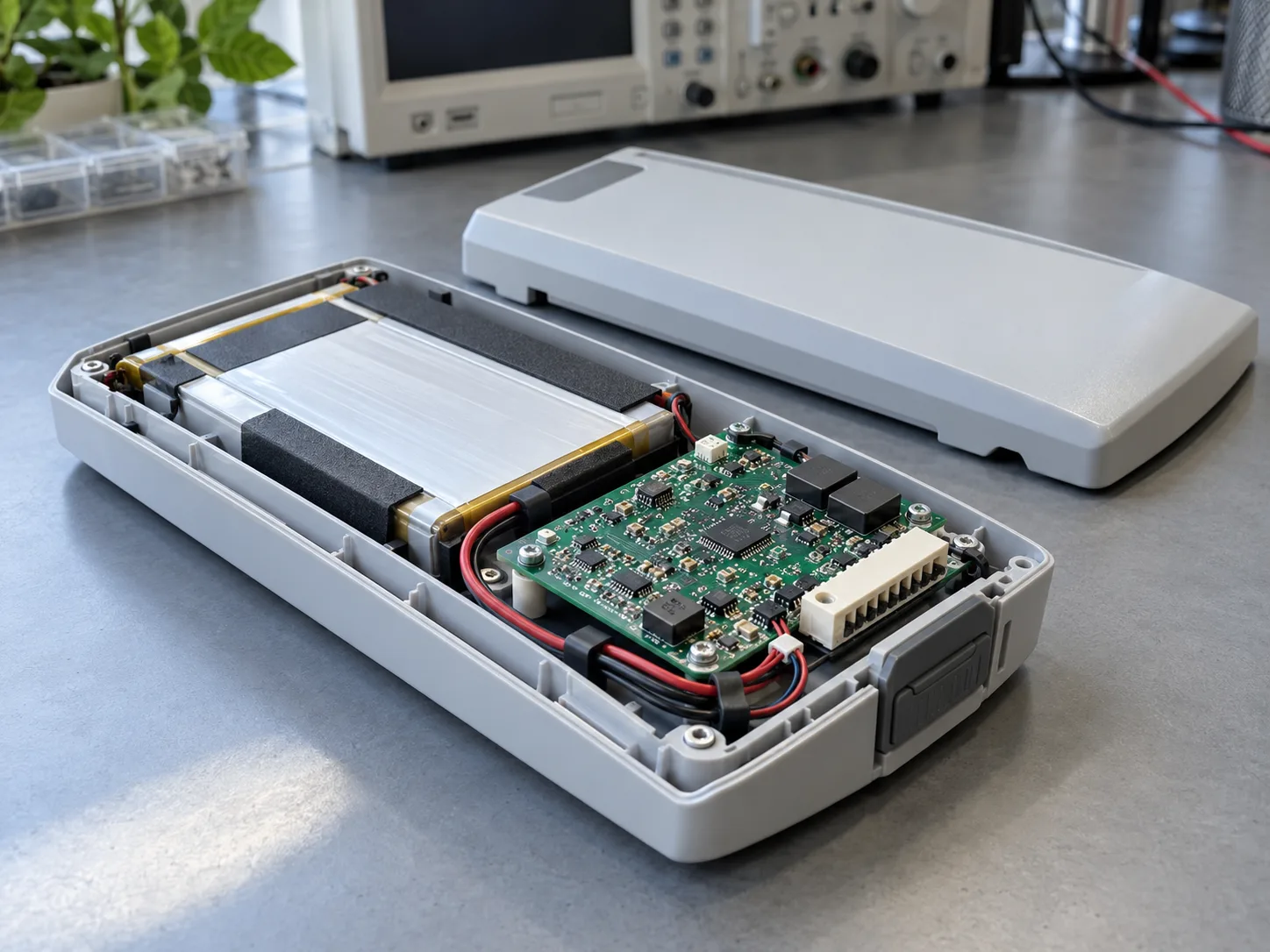
Application and product images are illustrative concepts.
02 / ENGINEERING
Safety starts
with the system.
A battery is part of the equipment power architecture. AJ Power works with OEM teams on cell selection, pack design and BMS integration around the agreed application requirements.
Protection architecture
Define sensing, protection thresholds and fault response. Where independent secondary protection or redundant power paths are required, agree the architecture and validation plan with your device engineering team.
Charging & standby strategy
Review long periods on charge, charger compatibility, charge termination, temperature monitoring and storage conditions. Cycle-life and standby-life targets need defined operating and test conditions.
Integration & validation
Specify the installation envelope, connectors, communication interface, discharge profile and servicing needs. Validate the pack together with the equipment, charger and intended operating routine.
Protection shutdown and continuity of system power are separate design questions. Explore TI’s battery-backup reference architecture
03 / TESTING & DOCUMENTATION
Evidence for
the actual battery model.
Agree the test route for the battery, the equipment and the destination market. A transport test or cell report does not, by itself, establish approval of the complete medical device.
UN 38.3
Lithium battery transport requirements include design testing and a test summary. Confirm the applicable model and documentation for your shipment.
PHMSA transport guidanceIEC 62133-2
This standard addresses safety of portable, sealed, rechargeable lithium cells and batteries. Confirm its applicability and the required edition with your test laboratory.
IEC scope and publicationUL evaluation
UL 1642 and UL 2054 are among the battery standards used in product evaluation. The relevant route depends on the cell, pack and end equipment.
UL battery testing overviewThese references explain test scopes; they are not a declaration that every AJ Power pack holds each listed certification. Request the documentation applicable to the proposed model.
04 / OEM DEVELOPMENT
From your device brief
to a validation plan.
- 01
Define
Share the application, voltage, capacity, load profile and installation space.
- 02
Design
Review cell selection, protection, charging interface and mechanical fit.
- 03
Validate
Agree prototype checks, system testing and required documentation.
- 04
Plan production
Confirm the approved configuration, quality criteria and production requirements.
BEFORE THE FIRST REVIEW
A few practical questions.
Can you replace an existing battery pack?
Share the original pack data, charger information, connector pinout and installation dimensions. A replacement should be reviewed for electrical, mechanical and charging compatibility before any drop-in claim is made.
Is LiFePO4 always the right chemistry?
Chemistry should follow the device requirements. Runtime, space, weight, current, charging conditions and the test route all belong in the review. A generic chemistry label is not a substitute for a pack specification.
What do you need for an engineering review?
Start with voltage, capacity, mounting space and continuous or peak discharge requirements. Add the equipment type, charger details, duty cycle, target market and expected production quantity if available.
LET’S DEFINE THE RIGHT BATTERY
Your equipment.
Your battery brief.
Tell us the application, voltage, capacity, installation space and discharge requirements. AJ Power can review the fit, interfaces and next engineering steps with your team.
Start with your device requirements.
Request a mobility battery engineering review Browse lithium battery packs