
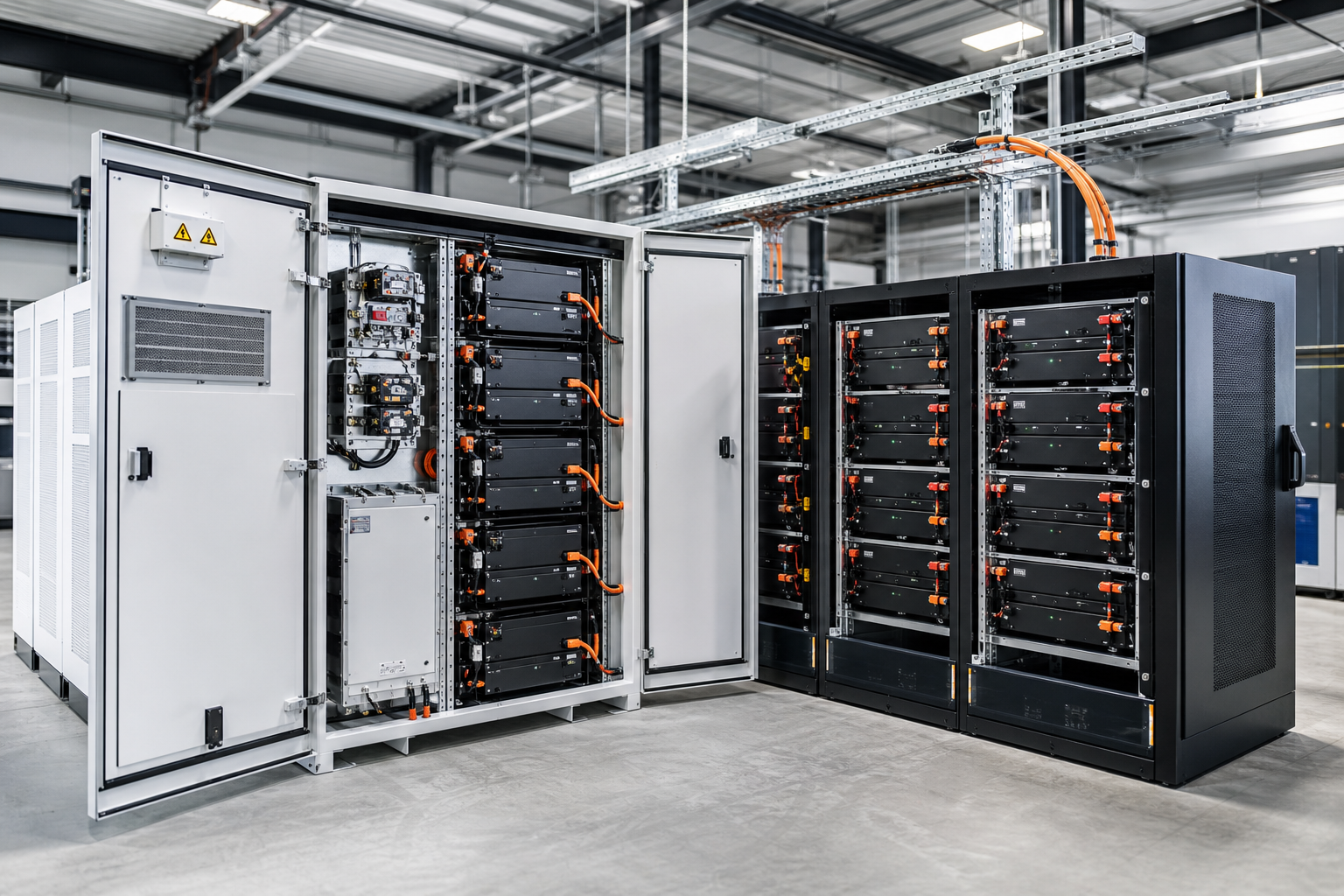
Choosing between LiFePO4 and lithium ion batteries is not a reversible decision. The wrong chemistry can mean defending higher replacement costs, explaining downtime, or facing insurance complications after a safety incident. Most buyers focus on headline cycle life or price per kWh, but the real risk sits in the details: installation environment, safety standards, and the fine print of supplier guarantees. This guide translates technical differences into commercial consequences, giving you the language and criteria to defend your choice internally and to suppliers.
What is the technical difference between LiFePO4 and lithium ion batteries?
LiFePO4 (lithium iron phosphate) and lithium ion (typically lithium nickel manganese cobalt oxide, or NMC) differ in cathode material, which drives their performance and risk profile. LiFePO4 uses iron phosphate, resulting in a nominal cell voltage of 3.2V and a flatter discharge curve, while NMC cells run at 3.6–3.7V. This affects pack design, energy density, and compatibility with existing systems. For B2B buyers, the chemistry determines not just runtime, but also cycle life, safety, and the technical requirements for installation and certification.
LiFePO4 batteries are generally heavier and larger per kWh than NMC, but offer greater thermal stability. NMC batteries, by contrast, provide higher energy density, which can reduce cabinet size or weight in space-constrained applications. The right choice depends on whether your installation prioritizes footprint or operational safety.
When specifying a custom battery pack, clarify the chemistry with your supplier and request the cell datasheet. This avoids confusion, as some vendors use “lithium ion” generically, which can hide critical differences in cycle life and safety.
How do cycle life and depth of discharge affect total cost?
Cycle life is the number of full charge/discharge cycles a battery can deliver before capacity drops below 80% of original. At 80% depth of discharge (DoD), LiFePO4 typically achieves 2,000–8,000 cycles, while NMC lithium ion ranges from 1,200–3,000 cycles. The range depends on cell quality, temperature, and charge rates.
For buyers, cycle life translates directly into replacement intervals and cost per cycle. If two suppliers quote the same kWh capacity, divide the total quoted price by the rated cycle count to compare cost per cycle. This figure is often lower for LiFePO4, especially in applications with daily cycling, such as energy storage systems or UPS backup.
However, NMC batteries may be more cost-effective for applications with infrequent cycling or where space is at a premium. Always match cycle life claims to the DoD and temperature conditions stated in the supplier’s datasheet, as overstated figures can lead to unexpected early replacements.
What are the safety and certification differences between LiFePO4 and NMC lithium ion?
LiFePO4 chemistry is less prone to thermal runaway than NMC, reducing fire risk. This is a significant factor for installations in occupied buildings, data centers, or locations with strict insurance requirements. NMC batteries require more robust battery management systems (BMS) and may need additional fire suppression or ventilation, which adds to installation cost and complexity.
Certification standards such as IEC 62619 (for industrial batteries), UL 1973 (stationary applications), and UN 38.3 (transport) apply to both chemistries. However, some insurance providers or local authorities may impose stricter requirements on NMC installations due to higher incident rates. Always request test reports for the exact model and configuration you intend to purchase, not just for the cell type.
For buyers, the cost of non-compliance can include denied insurance claims or forced system shutdowns. Factor certification status and the cost of meeting local fire codes into your procurement decision.
How do energy density and footprint affect installation and shipping?
NMC lithium ion batteries offer higher gravimetric and volumetric energy density—typically 180–220 Wh/kg and 400–600 Wh/L—compared to LiFePO4’s 90–160 Wh/kg and 220–350 Wh/L. This means NMC packs can be smaller and lighter for the same capacity, which matters in mobile or space-limited installations.
However, higher energy density increases risk in the event of mechanical damage or overheating. LiFePO4’s lower energy density can be an advantage in stationary applications where footprint is less critical, but safety and cycle life are prioritized.
Shipping regulations (such as UN 38.3) apply to both, but some carriers impose additional restrictions or surcharges on NMC due to higher hazard classification. When sourcing internationally, confirm that your supplier can provide compliant packaging and documentation for your chosen chemistry.
What are the key specification parameters to compare when sourcing OEM battery packs?
When comparing LiFePO4 vs lithium ion battery packs from OEM suppliers, focus on these parameters:
- Rated capacity (Ah and kWh) at specified voltage
- Cycle life at stated DoD and temperature
- Continuous and peak discharge current
- Operating temperature range
- Physical dimensions and weight
- Certification status (IEC, UL, UN)
- Integrated BMS features (overcurrent, overvoltage, temperature protection)
Request a technical datasheet for each quoted product and build a comparison table. Only compare quotes for packs with matching specifications. If a supplier omits cycle life or only provides a range, ask for the test method and conditions.
| Parameter | LiFePO4 | NMC Lithium Ion |
|---|---|---|
| Nominal Cell Voltage | 3.2V | 3.6–3.7V |
| Cycle Life (80% DoD) | 2,000–8,000 | 1,200–3,000 |
| Energy Density (Wh/kg) | 90–160 | 180–220 |
| Thermal Runaway Risk | Low | Moderate–High |
| Certification Requirements | IEC 62619, UL 1973, UN 38.3 | IEC 62619, UL 1973, UN 38.3 |
How does temperature affect performance and lifespan?
Both LiFePO4 and NMC lithium ion batteries lose capacity and cycle life at high temperatures, but NMC is more sensitive to thermal stress. At 40°C, NMC cycle life can drop by 30–50% compared to 25°C, while LiFePO4 may see a 20–30% reduction. Cold temperatures also reduce available capacity, but LiFePO4 is less prone to lithium plating during charging below 0°C, which can cause permanent damage in NMC cells.
For installations in hot climates or unconditioned spaces, LiFePO4 offers a margin of safety and longer service intervals. Always specify the expected ambient temperature in your RFQ and request cycle life data at that temperature.
Some suppliers offer low-temperature charging protection or integrated heaters. These features add cost but can prevent early failure and warranty disputes.
What are the typical failure modes and warranty risks for each chemistry?
LiFePO4 batteries most commonly fail due to overcharging, deep overdischarge, or BMS malfunction. NMC lithium ion batteries are more vulnerable to thermal runaway, internal short circuits, and capacity fade from high-rate cycling or elevated temperatures.
Warranty terms often exclude failures caused by operation outside specified limits. For both chemistries, clarify the warranty’s cycle count, allowable DoD, and temperature range. Ask for a sample warranty document before placing a volume order.
In B2B procurement, the cost of a warranty dispute is not just the replacement battery, but also lost production or service downtime. Choose suppliers who can document root cause analysis for returned packs and offer technical support for installation and commissioning.
How should buyers evaluate OEM and custom battery suppliers?
Supplier evaluation for LiFePO4 vs lithium ion battery packs should focus on technical transparency, production quality, and after-sales support. Request cell and pack-level test reports, including cycle life, safety, and certification results. Ask for a reference list of similar projects or installations.
For custom battery pack assembly, confirm that the supplier can configure BMS and enclosures to your requirements. Review their change control process and ability to provide consistent cell sourcing over the project lifetime.
Site audits or third-party factory inspections can reveal process weaknesses that affect long-term reliability. For international shipments, verify the supplier’s export documentation and packaging compliance for your destination market.
What procurement questions should be asked to avoid hidden costs?
To avoid hidden costs when sourcing LiFePO4 or lithium ion batteries, ask suppliers:
- What is the rated cycle life at my required DoD and temperature?
- Are all certifications valid for the assembled pack, not just the cells?
- What are the shipping restrictions or surcharges for my destination?
- What is the process for warranty claims and root cause analysis?
- Can you provide a sample pack for testing before volume order?
Request a breakdown of all costs, including BMS, enclosure, certification, and shipping. Compare total landed cost per cycle, not just upfront price per kWh.
Where possible, have both suppliers quote the same voltage, capacity, and cycle life, then calculate cost per cycle for a fair comparison. This approach makes it easier to defend your procurement decision internally.
How do installation and maintenance requirements differ?
LiFePO4 batteries generally require less active cooling and fire protection than NMC lithium ion, which can reduce installation complexity and ongoing maintenance. NMC systems may need additional sensors, fire suppression, or ventilation, especially in large-scale or indoor applications.
Both chemistries require regular BMS monitoring and periodic firmware updates. For critical applications, specify remote monitoring capability and ensure your supplier provides technical support for integration.
Plan for end-of-life recycling or disposal. Some regions have stricter requirements for NMC due to cobalt content. Confirm that your supplier can provide documentation and support for compliant disposal.
What is the next step for buyers comparing LiFePO4 vs lithium ion?
Review your application’s cycle life, safety, and installation requirements against the technical data for both chemistries. Request detailed quotations and datasheets from shortlisted suppliers, specifying identical voltage, capacity, and cycle life. Calculate cost per cycle and factor in certification, shipping, and installation costs. Where possible, arrange for a sample pack to be tested in your application environment before committing to a volume order.
Frequently asked questions
Can LiFePO4 batteries be used as a direct replacement for NMC lithium ion packs?
LiFePO4 and NMC lithium ion batteries differ in voltage and energy density, so direct replacement is not always possible. Check system voltage, BMS compatibility, and physical dimensions before substituting one chemistry for another.
How does the cost per cycle compare between LiFePO4 and lithium ion batteries?
LiFePO4 batteries often have a higher upfront cost but deliver more cycles at 80% DoD, resulting in a lower cost per cycle for high-use applications. Always calculate using supplier-quoted cycle life and total pack cost.
What certifications should I require for imported battery packs?
For both LiFePO4 and NMC lithium ion, require IEC 62619 or UL 1973 for stationary use, and UN 38.3 for transport. Always request certification for the assembled pack, not just the cells.
AJPOWER-Battery