
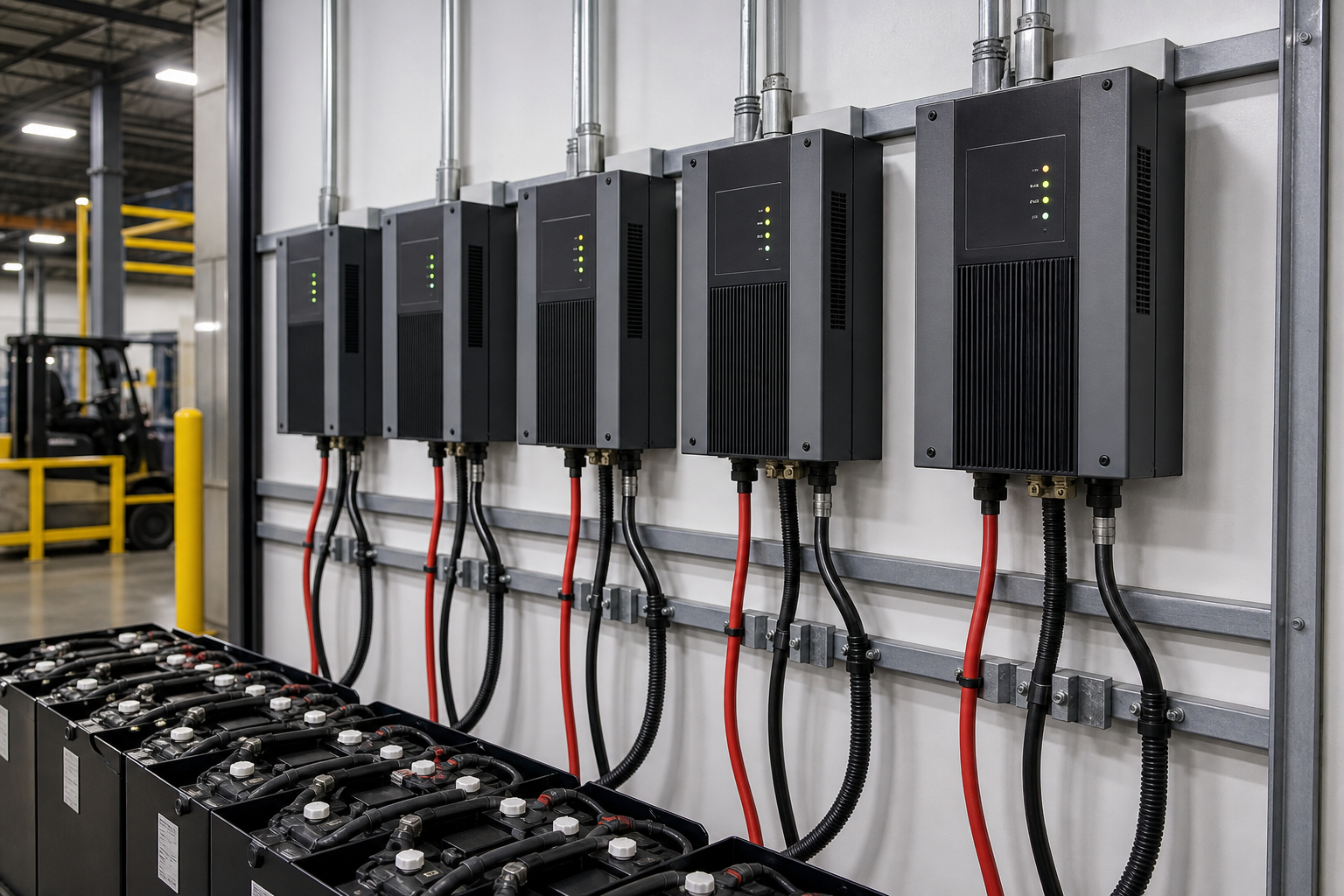
Undersized industrial battery chargers extend downtime and risk battery sulfation. Oversized chargers overheat cells and waste energy. The correct charger size, voltage, and certification prevent these failures and protect your investment. This guide explains how to select, compare, and source an industrial battery charger for B2B applications, with technical criteria and procurement steps grounded in international standards.
How do I size an industrial battery charger for my system?
Calculate charger current by dividing battery amp-hour (Ah) capacity by the required charge time in hours, then multiply by 1.2 to account for efficiency losses. For example, a 48V 200Ah battery charged in 8 hours: 200Ah ÷ 8h = 25A, then 25A × 1.2 = 30A charger output. Most industrial batteries tolerate 0.2C–0.3C charge rates (C = Ah capacity), but confirm with the battery datasheet. Charging faster than the rated C-rate shortens cycle life and voids warranties. Charging slower than 0.1C increases downtime and may cause stratification in flooded lead-acid cells.
Always match the charger output voltage to the battery nominal voltage. For a 48V system, use a charger with 48V output ±2%. A mismatch risks undercharging or cell damage. For lithium chemistries, confirm the charger’s end-of-charge voltage matches the battery management system (BMS) cutoff.
What charger types are used in industrial applications?
Industrial battery chargers fall into three main categories: ferroresonant, SCR (silicon-controlled rectifier), and high-frequency switch-mode. Ferroresonant chargers are robust and tolerate voltage fluctuations but are heavy and less efficient (70–80%). SCR chargers offer programmable profiles and 80–85% efficiency, but are bulkier than switch-mode types. High-frequency switch-mode chargers reach 90–94% efficiency, are compact, and support advanced charging profiles, but are sensitive to power quality and require filtered environments for long life.
Choose charger type based on installation environment, required efficiency, and maintenance resources. High-frequency chargers dominate new installations due to size and energy savings, except where grid quality is poor or electromagnetic interference is a concern.
Which standards and certifications apply to industrial battery chargers?
Key standards for industrial battery chargers include IEC 62040 (Uninterruptible Power Systems), UL 1564 (Industrial Battery Chargers), and EN 61000-6-2/4 (EMC immunity/emission). Request documented compliance from suppliers. For lithium battery systems, confirm the charger supports CAN bus or Modbus communication for BMS integration. Some markets require local certification (e.g., CE for Europe, CCC for China). Always verify the charger’s certification scope matches your installation country and battery chemistry.
- IEC 62040: General safety and performance
- UL 1564: North American safety for industrial chargers
- EN 61000-6-2/4: EMC for industrial environments
How do I compare industrial battery charger specifications?
Compare chargers by output voltage, output current, efficiency, supported battery chemistries, and communication interfaces. Use a table to normalize differences:
| Specification | Charger A | Charger B |
|---|---|---|
| Output Voltage | 48V ±1% | 48V ±2% |
| Max Output Current | 30A | 25A |
| Efficiency | 92% | 85% |
| Supported Chemistries | LiFePO4, Lead-acid | Lead-acid only |
| Communication | CAN, RS485 | None |
| Certifications | IEC 62040, CE | UL 1564 |
Normalize cost by dividing the quoted price by rated cycle life and matching technical specification. A lower up-front price with lower efficiency or shorter cycle life often costs more over time.
What procurement checks should I perform before ordering?
Request a full technical datasheet, certification documents, and a sample test report. Confirm the charger’s output matches your battery’s voltage and current requirements. Ask for references from similar installations. For large orders, request a factory audit or third-party inspection. Specify packaging, labeling, and delivery terms in the purchase agreement to avoid disputes.
- Technical datasheet with all electrical ratings
- Certification evidence for your market
- Sample test report from recent production
- References from similar projects
How do I ensure compatibility with my battery system?
Match charger output voltage and current to battery requirements within ±2%. For lithium systems, confirm charger supports BMS communication (CAN or RS485). Check the charger’s charging profile (constant current/constant voltage) matches the battery chemistry. For custom battery packs, provide the supplier with detailed battery specifications, including voltage, Ah, chemistry, and communication protocol. Incompatibility can cause overcharge, undercharge, or thermal runaway.
For mixed fleets (e.g., lead-acid and lithium), use programmable chargers with selectable profiles. Never use a charger with a fixed profile for a different chemistry.
What installation and maintenance factors affect charger performance?
Install chargers in ventilated, dust-free environments within 0–40°C ambient temperature. Poor ventilation or high temperatures reduce efficiency and shorten component life. Mount chargers vertically with at least 10cm clearance on all sides. For high-frequency chargers, install surge protection and EMI filters if the site has unstable power or sensitive equipment nearby.
Maintenance includes checking cable connections monthly, cleaning cooling fans, and verifying output voltage with a calibrated meter. Replace worn connectors and damaged cables immediately. Record maintenance in a log for warranty and troubleshooting.
What should I ask the factory before placing a bulk order?
Request the production lead time for your exact specification. Ask if the factory can customize output voltage, current, or communication interface. Confirm after-sales support and spare parts availability. For international shipments, clarify Incoterms, packaging standards, and warranty terms in writing. Factories with annual capacity above 1GWh are more likely to support large B2B orders with consistent quality, as seen with AJPOWER’s 2GWh/year cell and module capacity.
Final step: review your battery specifications, confirm charger compatibility, and request a technical assessment from the supplier before issuing a purchase order.
Frequently asked questions
Can I use one industrial battery charger for different battery chemistries?
Only if the charger has programmable profiles for each chemistry and supports required communication protocols. Fixed-profile chargers must not be used across chemistries.
What is the typical efficiency range for industrial battery chargers?
Ferroresonant: 70–80%, SCR: 80–85%, high-frequency switch-mode: 90–94%. Higher efficiency reduces energy loss and heat.
How do I verify a charger's certification?
Request the full certificate and test report from the supplier. Check that the certification (e.g., IEC 62040, UL 1564) matches your market and battery chemistry.
AJPOWER-Battery