
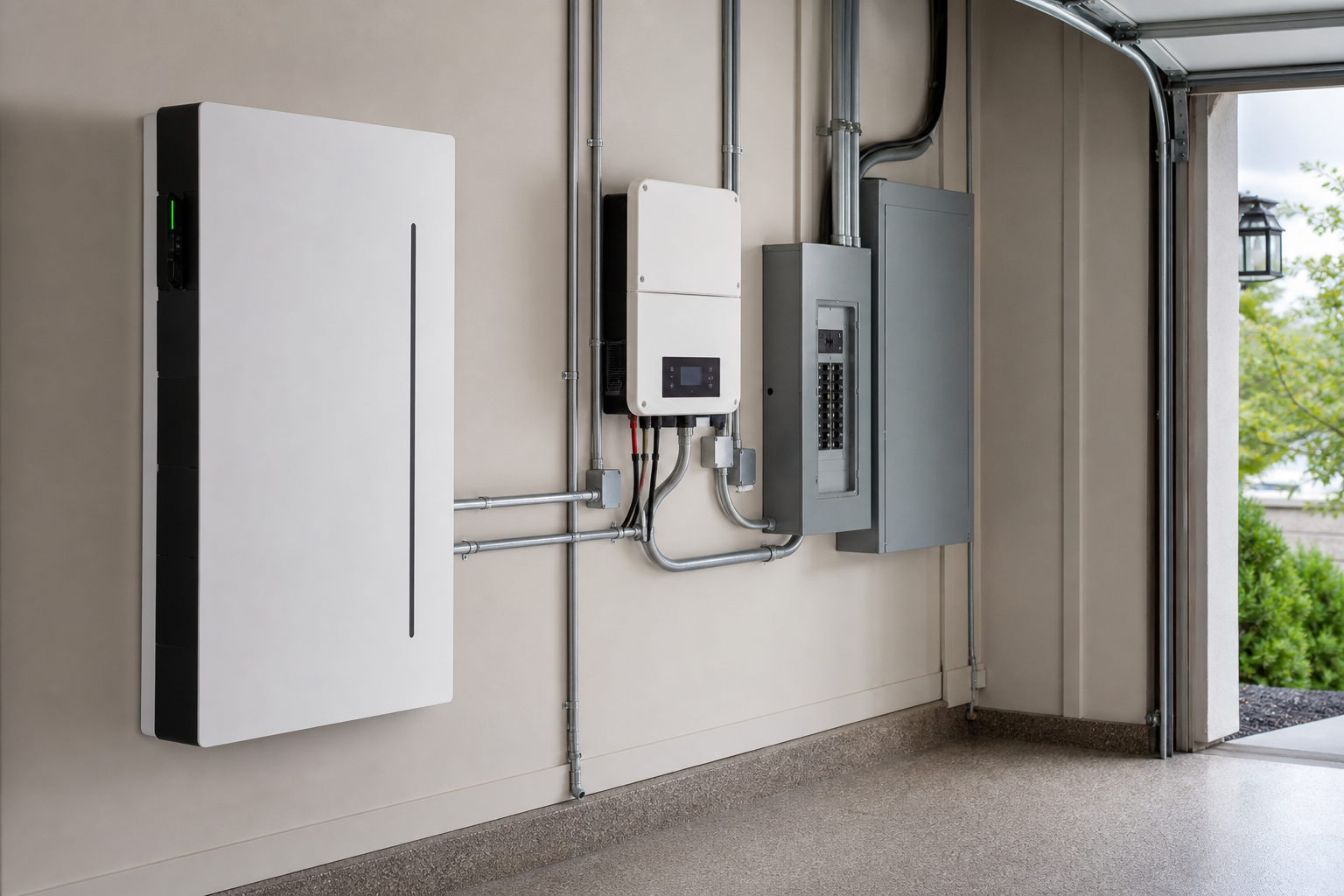
Most buyers assume home battery backup means solar plus storage. This fails when grid power is reliable but backup is required for outages, peak shaving, or critical loads. Home battery backup without solar is a distinct technical case. The system must be sized for grid charging, inverter compatibility, and seamless switchover. This guide details the technical requirements, sizing, and procurement checks for B2B buyers specifying home battery backup without solar.
What is a home battery backup without solar and when is it used?
A home battery backup without solar is an energy storage system charged from the grid, not from photovoltaic panels. It delivers power during outages, peak demand, or for critical loads. Typical use cases include regions with stable grids but frequent short outages, homes with no roof access, or buyers needing backup for medical or IT equipment. The system consists of a battery pack, inverter/charger, and transfer switch. No solar charge controller is required. The battery charges when grid power is available and discharges when the grid fails or during peak tariff periods.
Unlike solar-plus-storage, the system does not need to match solar array output. Instead, it must be sized for the home’s peak load and the required backup duration. This changes the sizing calculation and component selection. The absence of solar simplifies installation but places all charging cycles on the grid connection.
Buyers should specify the system for the actual outage profile: frequency, duration, and critical load. Over-sizing increases cost and footprint; under-sizing risks load shedding or system failure. Typical backup durations range from 2 to 12 hours, depending on local grid reliability and buyer requirements.
How do I size a home battery backup without solar?
Sizing a home battery backup without solar starts with the peak load in kilowatts (kW) and the required backup duration in hours (h). Multiply these to get the minimum energy storage in kilowatt-hours (kWh):
- Peak load (kW) × Backup hours (h) = Required capacity (kWh)
For example, a 4 kW peak load over 6 hours requires 24 kWh. Add 10-20% margin for inverter losses and battery inefficiency. For LiFePO4 batteries, use 80% Depth of Discharge (DoD) for cycle life. So, for a 24 kWh usable requirement, specify 30 kWh nominal (24 kWh ÷ 0.8 = 30 kWh).
Compare this to the available battery modules. For modular systems, stack units to reach the required capacity. Always confirm the inverter can handle the peak load and surge requirements. For critical loads, size for the highest simultaneous demand, not average consumption.
Table: Sizing Example for 6-Hour Backup
| Peak Load (kW) | Backup Hours | Usable Capacity (kWh) | Nominal Capacity (kWh, 80% DoD) |
|---|---|---|---|
| 2 | 6 | 12 | 15 |
| 4 | 6 | 24 | 30 |
| 6 | 4 | 24 | 30 |
What technical specifications matter for backup-only systems?
Key technical specifications for home battery backup without solar include rated capacity (kWh), nominal voltage (V), maximum continuous and surge discharge current (A), cycle life at specified DoD, and temperature range. For LiFePO4, expect 6000 cycles at 80% DoD, -10°C to 50°C operating range, and 51.2V or higher nominal voltage for residential systems.
Grid-charged systems must specify inverter/charger compatibility. Confirm the battery BMS supports grid-tied inverter protocols (RS485, CAN). Overcurrent and short-circuit protection must match the inverter’s surge capability. For indoor installations, IP20 or higher is typical; outdoor requires IP54 or above.
Cycle life is a function of DoD and temperature. For example, 6000 cycles at 80% DoD at 25°C is standard. Higher temperatures reduce cycle life. Specify the installation environment and check the datasheet for derating curves.
How does grid charging affect battery selection and operation?
Grid charging places all cycling stress on the battery, with no solar input to share the load. This means the battery may cycle daily, especially if used for peak shaving. Select batteries rated for high cycle life and rapid charge/discharge. LiFePO4 chemistry is preferred for 4000-8000 cycles at 80% DoD.
Charger-inverter integration is critical. The inverter/charger must match the battery voltage and charge profile. For example, a 51.2V battery requires a compatible charger with programmable voltage and current limits. Overcharging or undercharging shortens battery life and voids warranties.
Grid charging allows precise scheduling. Buyers can program charging during off-peak tariffs and discharging during peak periods. This requires a programmable inverter/charger and a battery BMS that communicates with the inverter. Always confirm protocol compatibility before procurement.
What are the main installation and safety requirements?
Installation of home battery backup without solar must comply with local electrical codes (such as IEC 60364 or NEC 2023). Key requirements include correct cable sizing, overcurrent protection, and safe enclosure. For indoor installations, ensure adequate ventilation and fire-rated enclosures. For outdoor, specify IP54 or higher and protection against direct sunlight and water ingress.
Safety features must include overcurrent, short-circuit, overvoltage, undervoltage, and temperature protection. The battery management system (BMS) should provide real-time monitoring and fault shutdown. Emergency disconnects are mandatory in most jurisdictions.
Commissioning requires insulation resistance testing, functional verification of the inverter/charger, and BMS communication checks. Document all test results and keep them with the system records. Schedule periodic maintenance checks for connection tightness and BMS firmware updates.
How do I ensure compatibility with existing home electrical systems?
Compatibility with the existing home electrical system depends on voltage, phase, and inverter integration. Most residential systems use single-phase 230V or split-phase 120/240V. The inverter/charger must match the home’s supply. For three-phase loads, specify a three-phase inverter and battery bank.
Transfer switches are required to isolate the home from the grid during backup operation. Automatic transfer switches (ATS) provide seamless switchover; manual switches are lower cost but require user intervention. Confirm the switch rating matches the peak load.
Retrofit installations require a site survey. Check the main panel, subpanel, and critical load circuits. Some loads (HVAC, induction cookers) have high inrush currents; size the inverter and battery for these surges. Always verify local code requirements for backup systems.
What are the procurement checks for B2B buyers?
B2B buyers should request full technical datasheets for all components: battery, inverter/charger, BMS, and transfer switch. Confirm rated capacity, cycle life, DoD, voltage, current, and communication protocols. Ask for installation manuals and wiring diagrams.
Supplier support is critical. Confirm availability of technical support, spare parts, and warranty terms. For large projects, request a sample unit for functional testing before bulk order. Compare suppliers on technical compliance, not just headline capacity or price.
Table: Procurement Checklist
| Item | Specification | Check |
|---|---|---|
| Battery | kWh, V, cycle life, DoD, BMS protocols | Datasheet, test report |
| Inverter/Charger | kW, V, phase, charge profile | Datasheet, compatibility |
| Transfer Switch | kW, phase, ATS/manual | Certification, rating |
| Installation | Manual, wiring, code compliance | Documentation |
How do cycle life and DoD affect long-term cost and reliability?
Cycle life and Depth of Discharge (DoD) determine the total usable energy over the battery’s life. For example, a 10 kWh battery with 6000 cycles at 80% DoD delivers 48,000 kWh (10 × 0.8 × 6000). Higher DoD increases usable capacity per cycle but reduces total cycles. Most buyers select 80% DoD for LiFePO4 as the best trade-off between capacity and longevity.
To compare cost, divide the supplier’s quote by total lifetime kWh. This gives cost per kWh delivered. Always use the rated cycle life at the specified DoD and temperature. Avoid comparing headline capacity only; two batteries with the same nominal kWh may differ in lifetime output by 30% or more.
Reliability depends on installation environment, charge/discharge rate, and BMS quality. Specify batteries with published cycle life data at the intended DoD and temperature. For critical applications, derate cycle life by 10-20% for safety margin.
What are the main trade-offs in battery chemistry and form factor?
LiFePO4 (lithium iron phosphate) is preferred for home battery backup without solar due to 4000-8000 cycles at 80% DoD, low fire risk, and stable performance from -10°C to 50°C. Lead-acid is lower cost but offers 800-1500 cycles at 50% DoD and requires more frequent replacement. NMC lithium offers higher energy density but shorter cycle life and higher cost per cycle.
Form factor affects installation. Wall-mounted batteries save floor space but are limited to 5-10 kWh per unit. Stackable or rack-mounted systems scale to 30 kWh or more but require dedicated space and heavier installation. For outdoor use, specify IP54 or higher and weatherproof enclosures.
Table: Chemistry and Form Factor Comparison
| Chemistry | Cycle Life (80% DoD) | Temp Range (°C) | Form Factor |
|---|---|---|---|
| LiFePO4 | 4000-8000 | -10 to 50 | Wall, stack, rack |
| Lead-acid | 800-1500 | 0 to 40 | Rack, floor |
| NMC lithium | 2000-4000 | 0 to 45 | Wall, stack |
How do I plan for future expansion or integration?
Plan for future expansion by specifying modular battery systems with stackable or parallel connection capability. Confirm the BMS supports expansion and the inverter can handle increased capacity. For integration with future solar, select an inverter/charger with solar input and MPPT capability, even if not used initially.
Communication protocols matter for smart home integration. Select batteries and inverters with open protocols (RS485, CAN, Modbus) for compatibility with energy management systems. Document all settings and firmware versions for future upgrades.
Expansion may require electrical panel upgrades or additional transfer switches. Confirm space, ventilation, and code compliance for the maximum planned system size, not just the initial installation.
What are the key maintenance and monitoring requirements?
Maintenance for home battery backup without solar includes periodic inspection of connections, firmware updates for BMS and inverter, and monitoring of cycle count and capacity fade. Most LiFePO4 systems require minimal maintenance but should be checked quarterly for connection tightness and error logs.
Remote monitoring is recommended for B2B buyers. Specify systems with integrated monitoring via web or app, with alerts for faults or abnormal operation. Data logging helps track cycle count, temperature excursions, and capacity loss over time.
Schedule annual professional inspection for insulation resistance, system grounding, and firmware updates. Document all maintenance actions for warranty and compliance purposes.
What is the next step for B2B buyers?
Review technical datasheets for battery, inverter/charger, and transfer switch. Confirm compatibility with site requirements and local codes. Request a technical assessment or site survey from the supplier. Prepare a procurement checklist and compare suppliers on technical compliance, support, and documentation. Avoid decisions based solely on headline capacity or price.
Frequently asked questions
Can a home battery backup without solar be upgraded to add solar later?
Yes. Specify an inverter/charger with solar input and MPPT capability. Modular battery systems and open communication protocols (RS485, CAN) allow later integration with solar PV arrays.
What is the typical cycle life for LiFePO4 batteries in backup-only systems?
LiFePO4 batteries typically offer 4000-8000 cycles at 80% Depth of Discharge (DoD) at 25°C. Actual cycle life depends on temperature, charge/discharge rate, and installation environment.
How should B2B buyers compare cost between battery suppliers?
Divide each supplier's quote by total lifetime kWh (nominal kWh × DoD × cycle life). This gives cost per kWh delivered, allowing direct comparison regardless of nominal capacity.
AJPOWER-Battery