
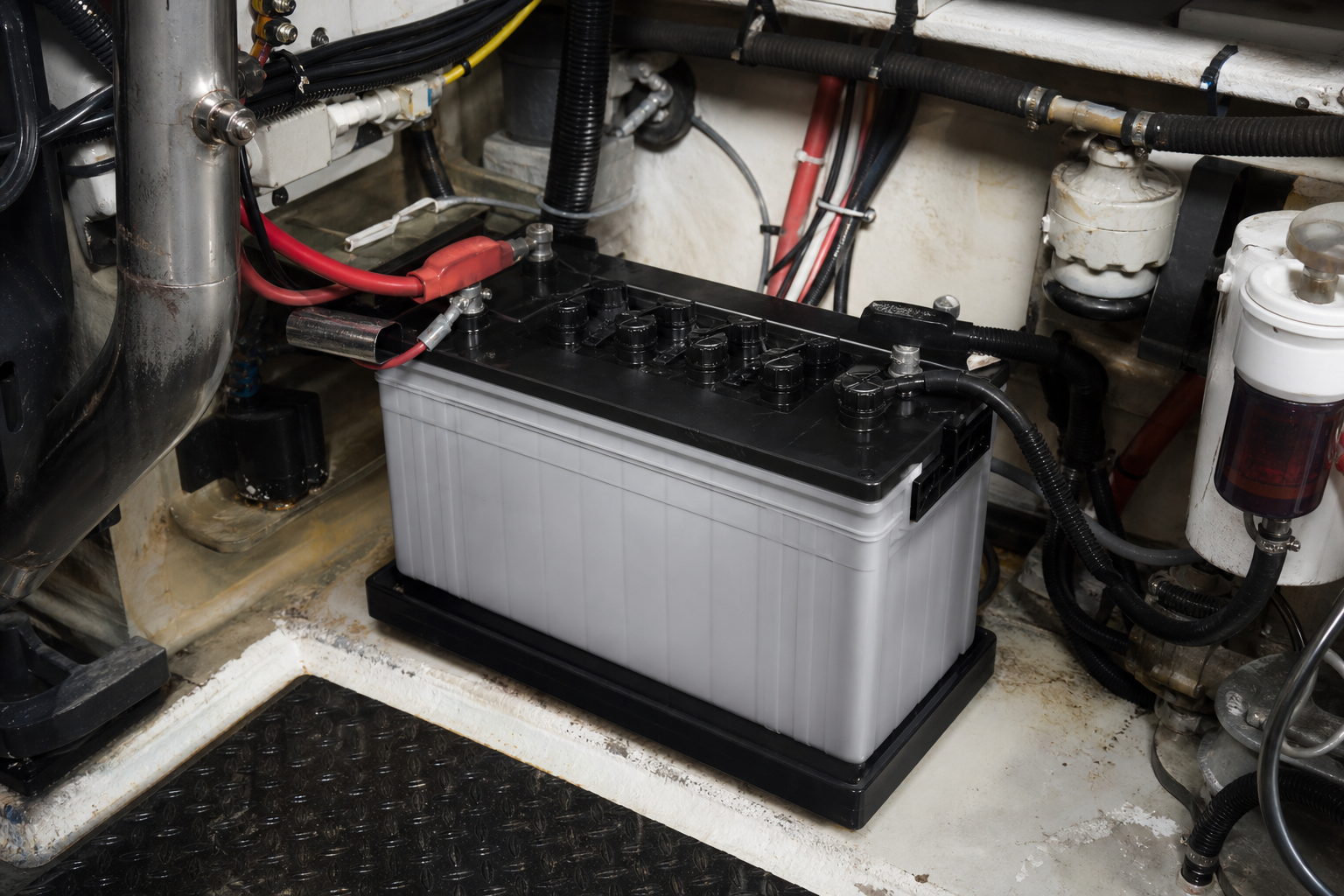
The most expensive mistake in marine battery procurement is choosing a dual purpose battery that fails either as a starter or as a deep-cycle supply. The result is not just a stranded vessel, but a replacement cycle your maintenance budget cannot absorb. This guide explains how to specify, compare, and source dual purpose marine batteries for industrial and OEM applications—translating technical points into real procurement risk and cost.
What defines a dual purpose marine battery and when is it required?
A dual purpose marine battery is designed to deliver both high cranking current for engine starting and sustained power for onboard loads. It is required in vessels where space or weight limits prevent separate starter and deep-cycle batteries. Typical applications include small commercial boats, workboats, and OEM marine systems with limited battery compartments.
Unlike dedicated starter batteries, dual purpose types must tolerate repeated deep discharges without rapid capacity loss. However, they cannot match the pure deep-cycle battery for total cycle life at high depth of discharge. The trade-off is a battery that can do both jobs, but with shorter life if either demand is extreme or poorly matched to the battery’s rating.
For B2B buyers, the risk is specifying a battery that meets only one of the two demands. If the cold cranking amps (CCA) are undersized, engines may fail to start in cold or emergency conditions. If the cycle life is overstated, replacement costs rise sharply after the first season of heavy use.
Which technical specifications matter most for dual purpose marine batteries?
The most critical specifications for a dual purpose marine battery are cold cranking amps (CCA), reserve capacity (RC), amp-hour (Ah) rating, cycle life at stated depth of discharge (DoD), and enclosure ingress protection (IP) rating. Each directly affects operational risk and cost.
CCA determines whether the battery can reliably start the engine under worst-case conditions. RC and Ah rating indicate how long the battery can support onboard loads before voltage drops below usable levels. Cycle life, always stated at a specific DoD (e.g., 400 cycles at 80% DoD), predicts replacement interval and total cost of ownership.
IP rating (such as IP65) is non-negotiable for marine environments. A battery with insufficient enclosure protection risks water ingress, short circuit, or accelerated corrosion. Always confirm the IP rating with the supplier’s test report, not just a datasheet claim.
| Specification | Typical Range | Measurement Condition |
|---|---|---|
| CCA | 500–900 A | -18°C, 30s |
| Ah Rating | 70–120 Ah | 20-hour rate |
| Cycle Life | 300–600 cycles | 80% DoD |
| IP Rating | IP54–IP67 | IEC 60529 |
How do international standards affect marine battery selection?
Dual purpose marine batteries are covered by several standards, including IEC 60095 (lead-acid starter batteries), IEC 62619 (for lithium cells), and ABYC E-10 (American Boat and Yacht Council electrical systems). Each standard defines minimum safety, performance, and test conditions.
IEC 60095 specifies test methods for CCA, capacity, and vibration resistance. ABYC E-10 covers installation, overcurrent protection, and wiring. For lithium-based batteries, IEC 62619 addresses cell safety and system-level protections. A battery that lacks compliance with these standards may be rejected at import or fail insurance inspections.
Always request the supplier’s test reports and certificates. Confirm that the tests were performed on the actual product, not a similar model, and that the conditions match your application (e.g., vibration test severity for high-speed craft).
What are the main failure modes and how do they impact cost?
The most common failure modes for dual purpose marine batteries are plate sulfation (in lead-acid), thermal runaway (in lithium), water ingress, and early capacity fade from repeated deep cycling. Each failure mode has a direct cost implication.
Plate sulfation occurs when batteries are left partially charged, reducing CCA and capacity. This leads to premature replacement—often within a year if maintenance is poor. Thermal runaway, while rare in quality lithium batteries, can cause total loss and safety incidents if BMS or enclosure design is inadequate.
Water ingress is usually the result of insufficient IP rating or poor installation. The cost is not just the battery, but downstream damage to electrical systems. Early capacity fade from exceeding rated DoD or cycle count means higher replacement frequency and increased maintenance labor.
How should buyers compare cost and value between suppliers?
Comparing dual purpose marine battery offers requires more than headline capacity or CCA. The only valid basis is cost per cycle at the rated DoD, using the supplier’s quoted price and stated cycle life. For example, divide the quoted price by the number of cycles at 80% DoD to compare offers directly.
Request both suppliers quote the same specification—voltage, Ah rating, CCA, IP rating, and cycle life at the same DoD. Ask for the full test report and warranty terms. If one supplier omits cycle life or test conditions, treat the offer as incomplete and high risk.
Beware of offers with high CCA but low cycle life, or vice versa. A battery that excels at one but fails at the other will cost more in unplanned downtime or early replacement. Always check that the quoted cycle life matches your actual usage profile.
| Comparison Factor | What to Request |
|---|---|
| Cycle Life | Test report at stated DoD |
| CCA | Test data at -18°C |
| IP Rating | Certificate or test report |
| Warranty | Terms in writing |
What are the key questions to ask an OEM or custom battery supplier?
When sourcing a dual purpose marine battery as an OEM or for industrial integration, ask suppliers for the following: detailed cell chemistry (lead-acid, AGM, LiFePO4), cycle life at your required DoD, CCA at -18°C, IP rating, and full bill of materials. Request a sample test report for the exact configuration you intend to order.
Clarify whether the supplier can provide custom cable lengths, connectors, or mounting hardware. For lithium batteries, confirm the BMS features: overcurrent, overvoltage, and thermal protection. Ask about production lead time and batch-to-batch consistency, as variation here can cause shipment delays or warranty disputes.
Finally, request references for similar marine or industrial projects. A supplier with experience in your application is less likely to miss critical requirements or compliance steps.
How do installation and maintenance affect battery life and risk?
Proper installation and maintenance are as important as battery specification. Incorrect cable sizing, loose terminals, or poor ventilation can cause overheating, voltage drop, or even fire risk. Always follow ABYC E-10 or IEC 60092-504 for installation wiring and protection.
Routine maintenance—checking electrolyte levels (for flooded lead-acid), inspecting terminals for corrosion, and verifying charge voltage—extends both CCA and cycle life. For lithium batteries, periodic BMS diagnostics and firmware updates may be necessary.
Neglecting these steps shortens battery life, increases replacement frequency, and can void supplier warranties. The cost is not just the battery, but lost vessel availability and increased labor.
What is the next step for buyers considering dual purpose marine batteries?
Review your vessel’s starting and deep-cycle load requirements, then specify the minimum CCA, Ah rating, cycle life, and IP rating needed. Prepare a technical specification sheet and request matching offers from at least two suppliers, including full test data and warranty terms. If your application is non-standard, request a technical assessment or sample test from the supplier before committing to volume orders.
Frequently asked questions
How do I calculate the correct size for a dual purpose marine battery?
Sum the maximum engine starting current (CCA) and the total amp-hour demand for onboard loads. Choose a battery with CCA and Ah ratings that meet or exceed these figures, and confirm cycle life at your expected depth of discharge.
What standards should a dual purpose marine battery comply with for export?
Key standards include IEC 60095 for lead-acid, IEC 62619 for lithium, and ABYC E-10 for installation. Always request actual test reports and certificates for the specific battery model you intend to purchase.
What is the risk of using a battery with an insufficient IP rating in marine environments?
A battery with a low IP rating risks water ingress, which can cause short circuits, corrosion, or total battery failure. Always confirm the IP rating with a test report to avoid costly failures and compliance issues.
AJPOWER-Battery