
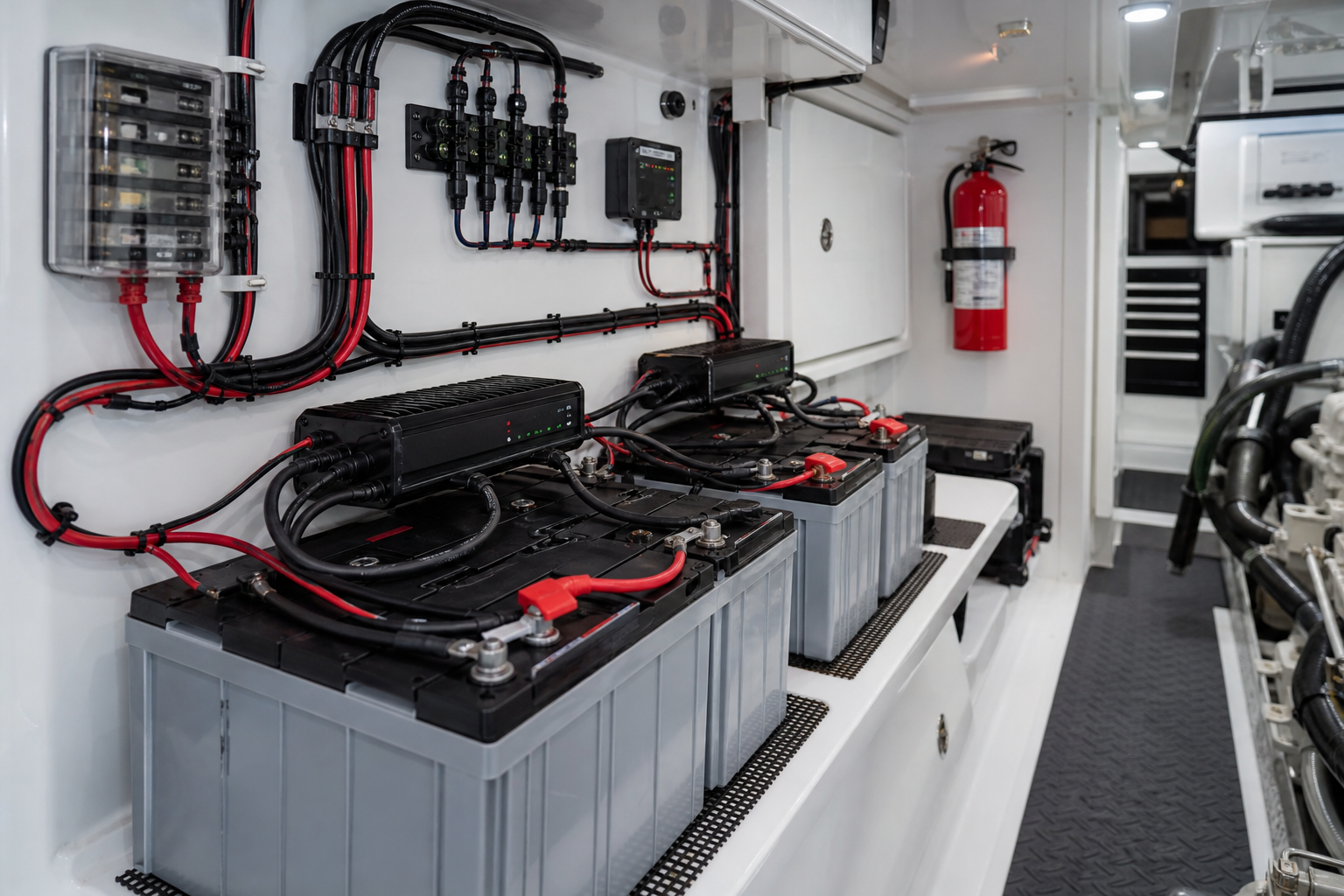
Choosing the wrong boat battery maintainer can quietly cost a fleet operator or distributor thousands in premature battery replacements, warranty claims, and lost time. Most buyers assume any maintainer rated for the nominal voltage will do, but mismatched charging profiles or connectors can cut battery life by a third or trigger BMS lockouts. This guide explains the technical and commercial risks, and gives you the language to specify, source, and defend your selection to both your technical team and your procurement manager.
What is a boat battery maintainer and how does it differ from a charger?
A boat battery maintainer is designed to keep batteries at full charge during periods of inactivity, using a low, regulated current and precise voltage control. Unlike standard chargers, maintainers are optimized for long-term connection and prevent overcharge or deep discharge. For B2B buyers, the distinction matters: a charger may recover a flat battery, but a maintainer preserves battery health over months, reducing replacement frequency and warranty claims.
Standard maintainers typically provide 0.5–3A output, with float voltages tailored to the battery chemistry (e.g., 13.5–13.8V for lead-acid, 13.8–14.6V for LiFePO4 with BMS). Using a charger as a maintainer risks overcharging or undercharging, both of which degrade battery performance and lifespan. For mixed fleets, specifying maintainers with selectable profiles or auto-detection can reduce inventory and compatibility headaches.
How do I match a boat battery maintainer to my battery type?
Matching a boat battery maintainer to your battery type is not just about voltage. The maintainer’s charge algorithm, float voltage, and temperature compensation must align with the battery’s chemistry and BMS requirements. For example, a 12V lead-acid battery typically requires a float voltage of 13.5–13.8V at 25°C, while a LiFePO4 pack may need 13.8–14.6V, with strict upper limits to avoid BMS lockout.
Failure to match these parameters can cause sulphation in lead-acid batteries or trigger protection circuits in lithium packs. The table below compares typical maintainer settings for common boat battery chemistries:
| Battery Chemistry | Float Voltage (25°C) | Current Limit | Temperature Compensation |
|---|---|---|---|
| Flooded Lead-Acid | 13.5–13.8V | 0.1C | -18mV/°C/cell |
| AGM/Gel | 13.6–13.8V | 0.1C | -12mV/°C/cell |
| LiFePO4 | 13.8–14.6V | 0.2C | None or BMS-managed |
What technical features should I specify to minimize risk?
Key technical features for a boat battery maintainer include precise float voltage control, current limiting, temperature compensation, and compatibility with the battery’s BMS. For B2B buyers, specifying these features in procurement documents reduces the risk of field failures and costly retrofits.
- Float Voltage Accuracy: ±0.05V tolerance is typical for lithium packs; wider tolerances can cause BMS disconnects.
- Temperature Compensation: Essential for lead-acid, less so for lithium. Absence can cause chronic under- or overcharge in variable climates.
- Connector Type: Mismatched connectors add installation cost and risk of reverse polarity. Specify industry-standard types (e.g., Anderson, ring terminals) in your RFQ.
- Charge Algorithm: Multi-stage (bulk, absorption, float) for lead-acid; single-stage or BMS-driven for lithium.
Requesting a sample for bench testing before bulk order is standard practice. Confirm the maintainer’s output with a calibrated meter under load to verify compliance with your specification.
How do I size a boat battery maintainer for fleet or OEM supply?
Sizing a boat battery maintainer is a function of battery capacity and expected parasitic loads during storage. The maintainer’s output current should be at least equal to the sum of self-discharge and any standby loads, but not exceed 0.1–0.2C to avoid overheating or BMS intervention.
For example, a 100Ah LiFePO4 pack with a 0.05A self-discharge and 0.2A standby load requires a maintainer rated for at least 0.25A. Oversizing the maintainer increases cost and may trigger BMS protection if the current exceeds the recommended limit. Undersizing leads to gradual discharge and potential deep-cycle damage.
- Calculate total standby load (A).
- Add battery self-discharge (A).
- Select maintainer with output ≥ total (A), but ≤ 0.2C of battery capacity.
What procurement checks reduce commercial and technical risk?
Procurement should require suppliers to provide detailed datasheets with float voltage, current range, charge algorithm, and connector type. For larger orders, request batch test reports or third-party verification of key parameters. Specify packaging, labeling, and documentation requirements to avoid customs or installation delays.
Include a clause for sample approval prior to mass production. This allows your technical team to verify compatibility and performance in your own environment. For international shipments, confirm the maintainer’s certifications (e.g., CE, UL, IEC 60335-2-29) match your market’s requirements, but do not assume compliance—request certificates and check their authenticity.
| Procurement Check | Risk Addressed |
|---|---|
| Float Voltage Specified | Prevents battery damage |
| Connector Type Confirmed | Reduces installation errors |
| Sample Approval | Verifies actual performance |
| Certification Verified | Ensures market access |
How do I confirm compatibility with existing boat battery systems?
Compatibility is confirmed by matching the maintainer’s output voltage, current, and connector to the battery’s requirements and the boat’s wiring. For lithium batteries with BMS, check that the maintainer’s voltage never exceeds the BMS’s upper limit, and that it does not trigger low-voltage disconnects during float.
For mixed fleets, consider maintainers with selectable or programmable profiles. This reduces SKU count and simplifies inventory, but requires disciplined installation practices to avoid misconfiguration. Always test the maintainer on a sample battery before fleet deployment.
What are common failure modes and how can they be prevented?
Common failure modes for boat battery maintainers include overcharge (leading to gassing or BMS lockout), undercharge (causing sulphation or deep discharge), connector failure, and thermal runaway. Most are preventable by specifying correct voltage, current, and connector type, and by verifying supplier claims with independent testing.
For B2B buyers, the cost of a single field failure can exceed the price difference between a compliant and a generic maintainer. Preventive measures include sample approval, batch testing, and clear installation instructions.
What is the next step for technical or procurement teams?
Review your current battery specifications and storage conditions, then draft a technical specification for your boat battery maintainer that includes float voltage, current, connector type, and charge algorithm. Request datasheets and samples from shortlisted suppliers, and verify performance with in-house testing before issuing a purchase order. This approach minimizes risk and supports a defensible procurement decision.
Frequently asked questions
Can a standard automotive battery maintainer be used for marine batteries?
Not always. Marine batteries may have different charging profiles, connectors, or environmental requirements. Using an automotive maintainer can cause undercharge, overcharge, or connector mismatch. Always match the maintainer to the battery's chemistry and application.
How often should a boat battery maintainer be checked or serviced?
For fleet or OEM use, check maintainers at least annually for output voltage accuracy, connector integrity, and signs of corrosion or overheating. In harsh marine environments, semi-annual inspection is recommended to prevent unnoticed failures.
What documentation should suppliers provide for a boat battery maintainer order?
Suppliers should provide a detailed datasheet (float voltage, current, charge algorithm), batch test reports, connector specifications, and certification documents (CE, UL, or IEC as required). Sample approval is recommended before mass order.
AJPOWER-Battery