
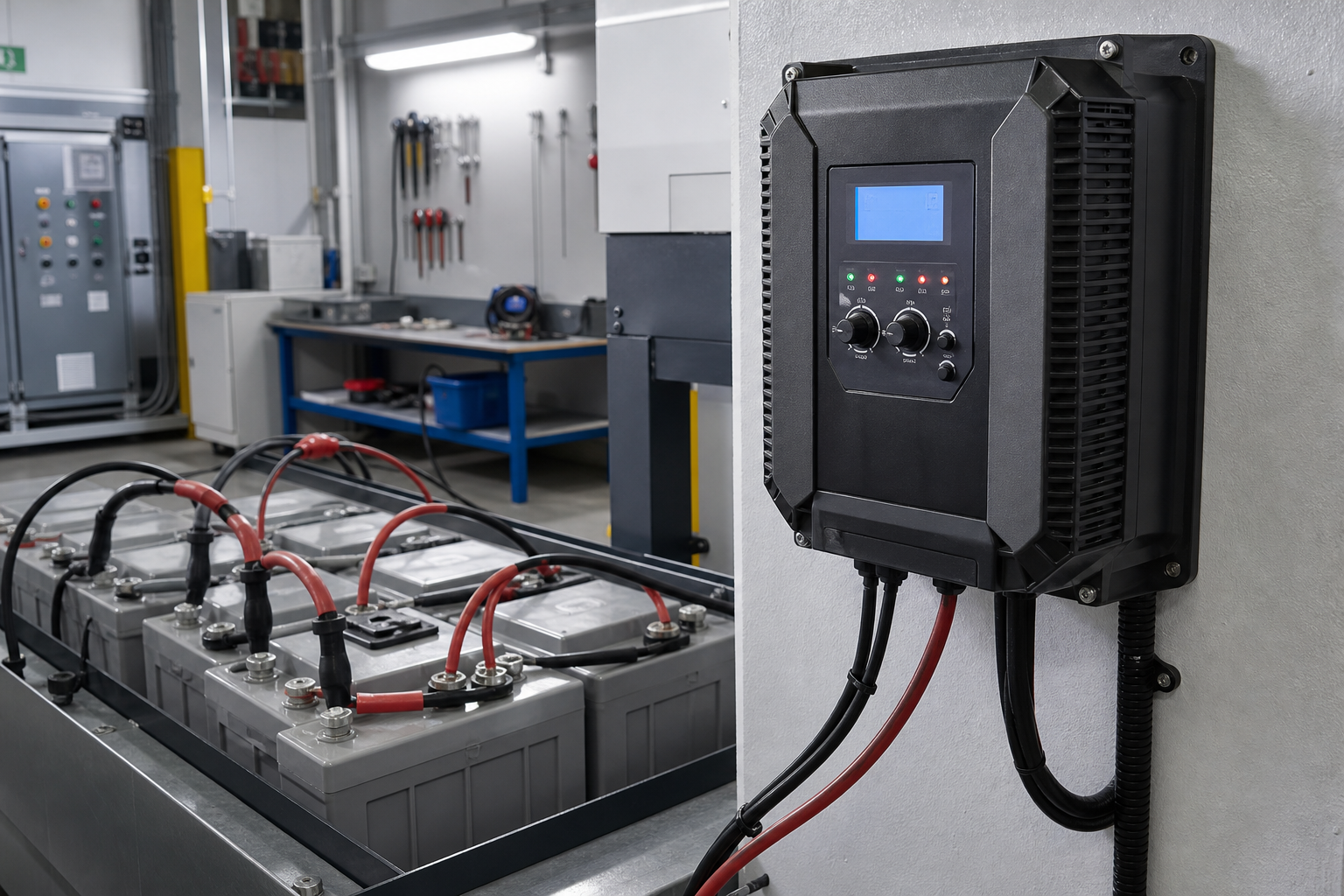
Buyers who overlook the technical and certification details of a battery charger with desulfation risk shipment delays, customs rejections, or field failures. Many assume any charger with a desulfation label is suitable for industrial or backup battery maintenance, but this is not the case. The difference between a careful and an inexperienced buyer is knowing what to verify before signing a purchase order.
What is a battery charger with desulfation and how does it work?
A battery charger with desulfation is designed to restore capacity in lead-acid batteries by breaking down lead sulfate crystals that form during deep discharge or long storage. This is typically achieved using high-frequency pulse or controlled overvoltage cycles. Not all chargers with a desulfation label use true pulse technology; some simply extend the absorption phase, which is less effective. Buyers should request a technical datasheet showing the desulfation method, pulse frequency (usually 3–10 kHz), and cycle duration.
For industrial batteries, desulfation is relevant for flooded and AGM lead-acid types, but not for lithium chemistries. Always confirm compatibility with the battery type in use. Ask the supplier: “Please provide the desulfation cycle parameters and confirm compatibility with [your battery chemistry].”
How does desulfation affect charger cost and procurement?
Adding desulfation capability typically increases charger cost by 10–20% compared to a basic model, but only if genuine pulse circuitry is used. Some suppliers relabel standard chargers with a desulfation sticker, offering no real technical difference. The cost impact is also affected by order volume, output current, and whether custom branding or enclosure modifications are required.
To compare costs, have both suppliers quote the same output voltage, current, and desulfation function. Then divide the quoted price by the rated cycle count or warranty period to estimate cost per cycle. Request: “Quote for 48V 20A charger with true pulse desulfation, including warranty and minimum order quantity.”
What certification and compliance checks are required?
Battery chargers with desulfation intended for industrial or backup use must comply with electrical safety and electromagnetic compatibility (EMC) standards. The most relevant are IEC 60335-2-29 for safety and EN 61000-6-3/6-1 for EMC. CE marking alone is insufficient unless backed by test reports for the exact model and configuration ordered.
Careful buyers request the full test report, not just a certificate. Confirm that the desulfation function is included in the tested firmware or hardware version. Ask: “Provide the IEC 60335-2-29 and EMC test reports for the quoted charger, including desulfation mode.”
| Standard | Scope | Required for |
|---|---|---|
| IEC 60335-2-29 | Electrical safety | All industrial chargers |
| EN 61000-6-3/6-1 | EMC (emissions/immunity) | Chargers in commercial/industrial use |
| CE Marking | Market access (EU) | Must be supported by above |
What are typical lead times and supply risks?
Lead times for a battery charger with desulfation range from 14 days for standard models to 30–60 days for custom or OEM-branded units. Delays often occur if certification is incomplete, if the supplier lacks in-house test capacity, or if enclosure modifications are requested. Inexperienced buyers may overlook the need for sample approval, resulting in shipment delays or non-conforming products.
Always confirm lead time for both samples and mass production. For example, AJPOWER quotes 7 days for samples and 30–45 days for mass production on energy storage systems, but this can extend for custom chargers. Ask: “Confirm lead time for sample and bulk order, including time for certification and branding.”
What technical details should be verified before purchase?
Key technical parameters include output voltage and current, desulfation cycle parameters (pulse frequency, duration), supported battery chemistries, and protection features (overvoltage, reverse polarity, thermal shutdown). Inadequate specification can result in field failures or warranty disputes.
Request a full specification sheet and confirm that the quoted model matches your battery type and use case. Ask: “Send detailed technical datasheet for the quoted charger, specifying desulfation cycle and protection features.”
| Parameter | Typical Range | What to Verify |
|---|---|---|
| Output Voltage | 12–96V | Matches battery system |
| Output Current | 5–50A | Suitable for charge rate |
| Pulse Frequency | 3–10kHz | True pulse desulfation |
| Battery Chemistry | Lead-acid only | Not for lithium |
How does freight classification and after-sales support affect procurement?
Chargers are typically classified as general electrical goods for freight, but if shipped with batteries, UN 3480/3481 (lithium) or UN 2794 (lead-acid) may apply. Incorrect classification can cause customs delays or increased shipping costs. Spare part availability and after-sales support are often overlooked; lack of local service can mean extended downtime in the event of a failure.
Ask suppliers: “Confirm freight classification for the charger and availability of spare parts in my region.” Compare after-sales support terms, especially for OEM or custom models.
What questions should buyers send to suppliers before ordering?
- “Provide technical datasheet specifying desulfation method, pulse frequency, and supported battery chemistries.”
- “Send IEC 60335-2-29 and EMC test reports for the quoted charger, including desulfation mode.”
- “Confirm lead time for samples and mass production, including certification and OEM branding if required.”
- “State spare part availability and after-sales support terms for my region.”
Careful buyers review these factors before placing an order. The next step is to request full technical documentation and certification reports for the exact charger model being considered, and to confirm lead time and after-sales support terms in writing.
Frequently asked questions
What is the main technical difference between a true desulfation charger and a basic charger?
A true desulfation charger uses high-frequency pulse or controlled overvoltage cycles to break down lead sulfate crystals, while a basic charger only charges at a fixed voltage and current without addressing sulfation.
Which certifications are required for industrial battery chargers with desulfation?
Industrial battery chargers with desulfation should be certified to IEC 60335-2-29 for electrical safety and EN 61000-6-3/6-1 for EMC. CE marking must be supported by these test reports.
How can buyers verify if the desulfation function is genuine?
Buyers should request a technical datasheet showing the desulfation method, pulse frequency, and test reports confirming the function is present in the certified hardware or firmware.
AJPOWER-Battery