
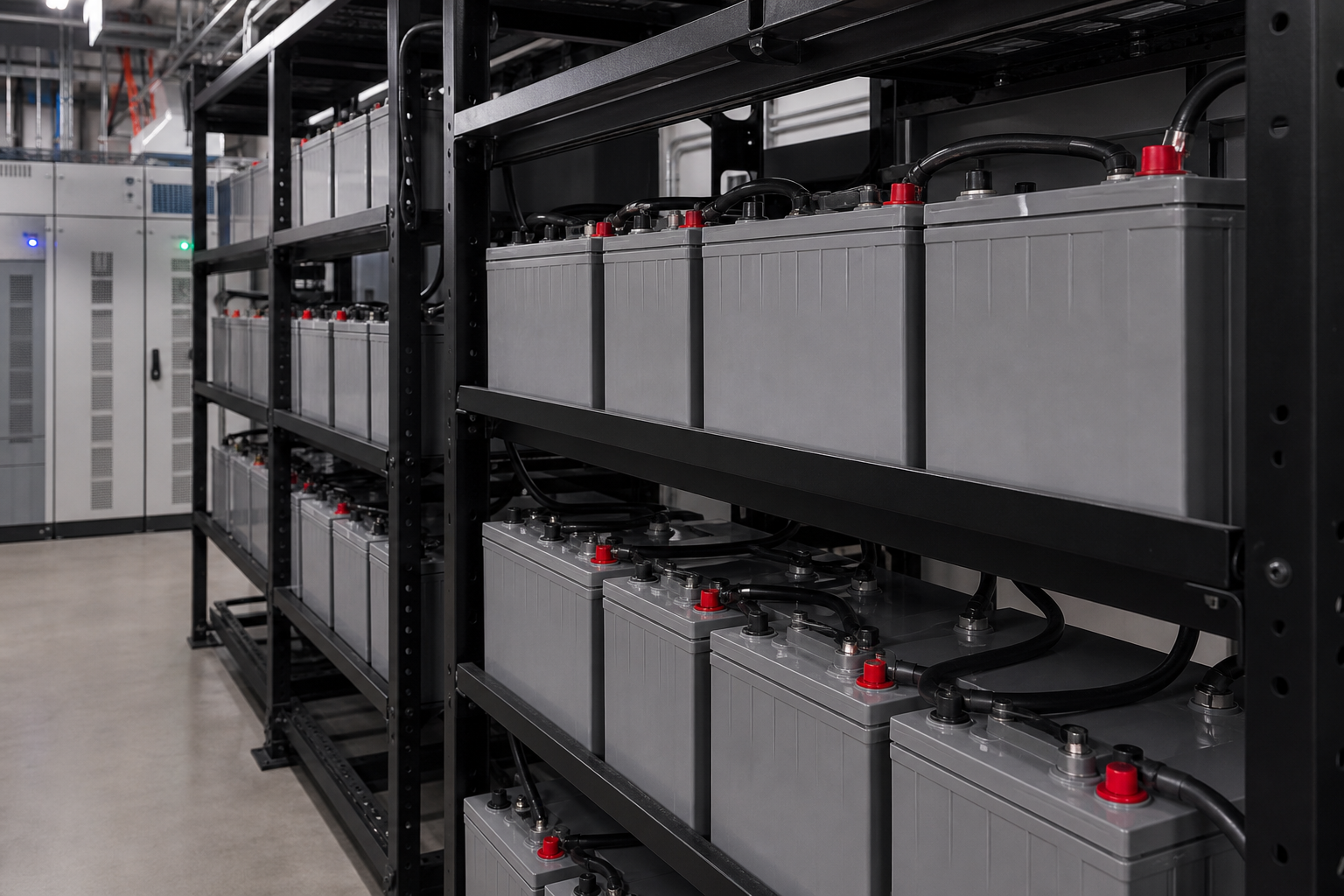
Failure to verify AGM VRLA battery specifications before ordering can lead to costly downtime, rejected shipments, or even safety incidents. Many buyers assume all batteries with the same voltage and capacity are interchangeable, but differences in cycle life, certification scope, and even terminal type can derail a project. This guide details the technical and commercial checks that separate careful buyers from those who learn the hard way.
What defines an AGM VRLA battery and how does it differ from other lead-acid types?
An AGM VRLA battery is a valve-regulated lead-acid battery using Absorbed Glass Mat separators to immobilise the electrolyte. Unlike flooded lead-acid batteries, AGM VRLA batteries are sealed, maintenance-free, and can operate in any orientation. Gel VRLA batteries, by contrast, use silica to gel the electrolyte, resulting in different charge acceptance and cycle life characteristics. AGM VRLA batteries are preferred in industrial backup and UPS applications for their lower internal resistance and higher discharge rates, but their cycle life is generally shorter than gel types under deep cycling.
Key differences between AGM and other lead-acid batteries include:
- Electrolyte immobilisation: AGM uses glass mat, gel uses silica, flooded uses liquid acid.
- Maintenance: AGM and gel are sealed and maintenance-free; flooded requires regular topping up.
- Orientation: AGM and gel can be installed sideways; flooded cannot.
- Cycle life: AGM typically 300–1200 cycles at 50% DoD; gel can reach 500–1500 cycles under similar conditions.
Which technical specifications matter most for industrial AGM VRLA battery sourcing?
For industrial buyers, the most critical AGM VRLA battery specifications are nominal voltage, rated capacity (Ah), cycle life at a defined depth of discharge (DoD), float and equalisation charge voltages, maximum discharge current, and operating temperature range. Cycle life claims are especially variable: a supplier quoting 1200 cycles may be referring to shallow (20% DoD) cycles, not the 50% or 80% DoD typical in real-world use. Always request the test conditions for any cycle life figure.
Other important parameters include terminal type, case material (flame retardant or not), and self-discharge rate. For backup power and UPS applications, low self-discharge and high-rate discharge capability are essential. Inconsistent terminal types or case sizes can complicate installation and maintenance.
How do IEC and UL standards apply to AGM VRLA batteries?
IEC 60896-21/22 and UL1989 are the primary standards governing industrial AGM VRLA batteries. IEC 60896-21/22 covers performance and safety for stationary lead-acid batteries, specifying tests for capacity, endurance, and safety vent operation. UL1989 certifies batteries for standby power, focusing on construction, performance, and fire safety.
Buyers should ask suppliers for complete test reports, not just certificates, to confirm compliance. Some suppliers only test a single model or size, while others test the full range. Ask: “Please provide the full IEC 60896-21/22 and UL1989 test reports for the exact model quoted, including all tested parameters and conditions.”
What are the common failure modes and commercial risks in AGM VRLA battery procurement?
Common failure modes for AGM VRLA batteries include premature capacity loss, thermal runaway, and case swelling due to overcharging or poor ventilation. Commercial risks stem from mismatched specifications, incomplete certification, and misrepresented cycle life. Inexperienced buyers often overlook the freight classification: AGM VRLA batteries are generally classified as non-hazardous for air and sea freight if properly packed, but incorrect paperwork can cause delays or fines.
Spare-part availability is another risk. Terminal adapters, mounting brackets, and replacement vent valves are not always included or available for all models. Confirm with suppliers: “What spare parts and accessories are available for this battery model, and what are their lead times?”
How should buyers compare AGM VRLA battery quotations?
To compare AGM VRLA battery quotations, buyers should standardise the specification: same voltage, capacity, cycle life at a defined DoD, and certification scope. Divide the quoted price by the rated cycle count to estimate cost per cycle. Request a breakdown of lead time, warranty terms, and included accessories.
| Specification | Supplier A | Supplier B |
|---|---|---|
| Voltage (V) | 12 | 12 |
| Capacity (Ah) | 100 | 100 |
| Cycle Life @ 50% DoD | 800 | 1200 |
| IEC 60896-21/22 | Full report | Certificate only |
| Lead Time (weeks) | 4 | 7 |
Ask suppliers: “Please confirm the cycle life test conditions, warranty coverage, and whether all certifications apply to the quoted model.”
What lead times and logistics issues should buyers expect?
Lead times for AGM VRLA batteries typically range from 2 to 8 weeks, depending on order volume, customisation, and raw material availability. Custom terminal types or flame-retardant cases can extend lead times. Shipping classification is usually non-hazardous, but incorrect paperwork or packaging can result in customs holds or reclassification as hazardous goods.
Buyers should clarify: “What is the standard lead time for this model and configuration? Are there any components or certifications that could delay shipment?” Confirming this before contract signing avoids costly project delays.
How can buyers verify supplier claims and avoid common sourcing pitfalls?
Verification starts with requesting full technical datasheets, test reports, and production references for the exact AGM VRLA battery model. Site audits or third-party inspections can uncover inconsistencies in materials or assembly. Inquire about after-sales support and spare-part logistics, as some suppliers lack inventory for older models.
Paste these checks into your supplier email:
- “Please provide the full IEC 60896-21/22 and UL1989 test reports for the quoted model.”
- “Confirm the cycle life test conditions (DoD, temperature, charge/discharge rate).”
- “List available spare parts and their lead times for this battery.”
- “What is your standard warranty and after-sales support process?”
What is the next step for buyers considering AGM VRLA batteries?
Review the technical datasheet and certification reports for the specific AGM VRLA battery model you plan to source. Confirm that the supplier’s quoted cycle life, lead time, and accessory availability match your project’s requirements. If any specification, certification, or logistics detail is unclear, request clarification before signing a contract. This risk-focused approach prevents costly errors and ensures your industrial battery procurement meets both technical and commercial needs.
Frequently asked questions
What is the typical cycle life of an AGM VRLA battery at 50% DoD?
Most industrial AGM VRLA batteries offer 300–1200 cycles at 50% depth of discharge (DoD). Always confirm the test conditions with the supplier.
Which certifications should I request for AGM VRLA batteries in industrial applications?
Request IEC 60896-21/22 and UL1989 test reports for the exact model quoted. Do not accept certificates for similar or older models.
Are AGM VRLA batteries classified as hazardous for shipping?
Properly packed AGM VRLA batteries are generally non-hazardous for air and sea freight, but incorrect paperwork can result in delays or reclassification.
AJPOWER-Battery