
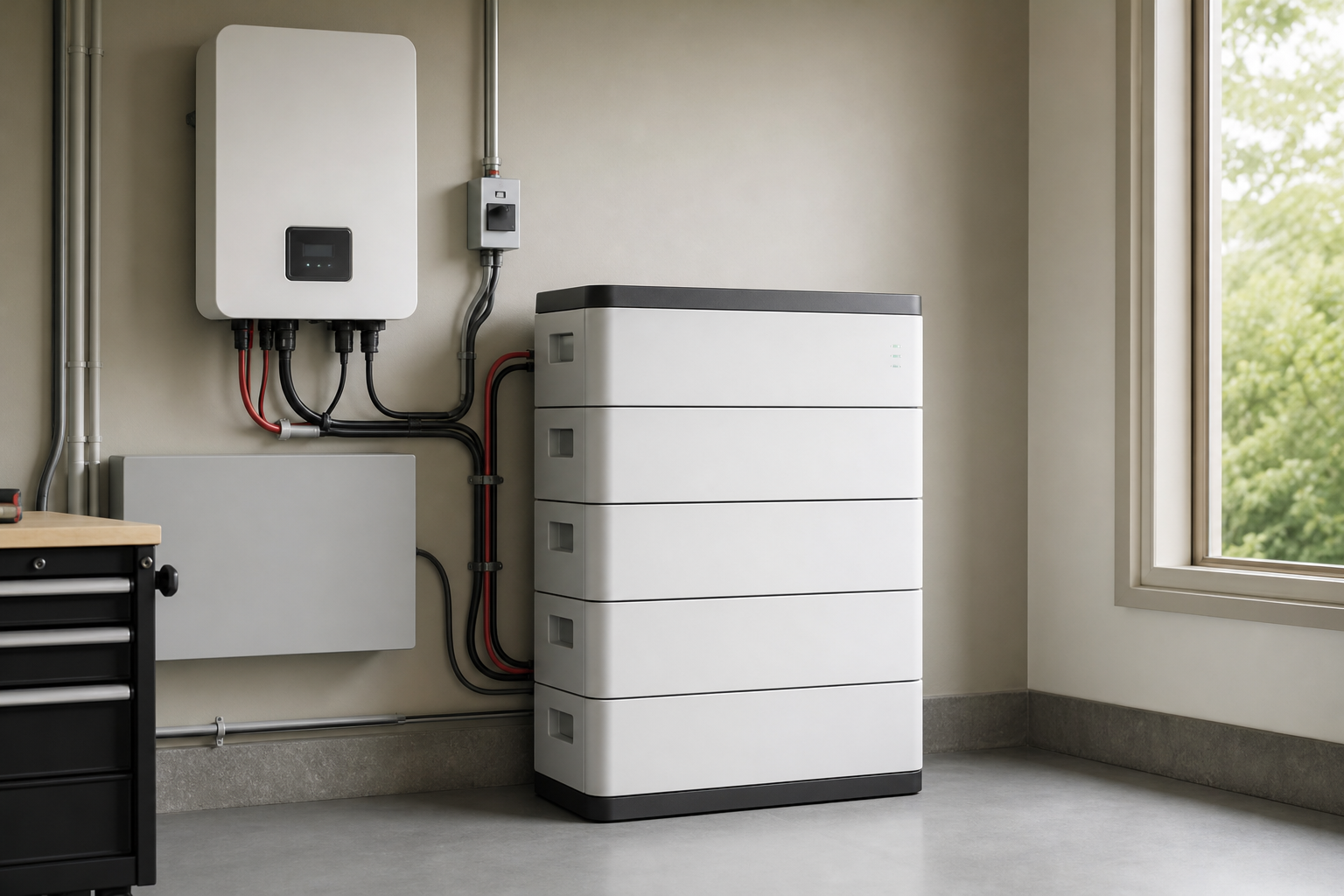
Most buyers assume that any 10 kWh home battery will cover a typical household’s backup needs, but the reality is more nuanced. Installation site, load profile, and certification requirements can turn a straightforward order into a costly mistake if not addressed up front. This guide breaks down the technical and commercial checks that matter most for installers and distributors sourcing 10 kWh home batteries.
How do I size a 10 kWh home battery for residential backup?
To size a 10 kWh home battery, start with the site’s daily load profile and backup expectations. A 10 kWh nominal capacity, when discharged to 80% depth of discharge (DoD), yields 8 kWh usable. For an average household drawing 1.5–2 kW, this covers 4–6 hours of backup. However, high-surge loads or longer outages require either a larger system or load prioritization. Always confirm whether the supplier’s stated capacity is nominal or usable, as this affects both runtime and cost justification.
Installers should also account for inverter compatibility. Most 10 kWh batteries are designed for 48V or 51.2V systems, but inverter input voltage and communication protocols (CAN/RS485) must match. Request a full datasheet and cross-check against the inverter’s requirements before committing.
What are the key technical specifications to compare?
Not all 10 kWh home batteries are built to the same standard. The most relevant technical specifications include:
- Nominal capacity and usable capacity (kWh)
- Voltage (typically 48V or 51.2V for residential ESS)
- Cycle life at 80% DoD (range: 4,000–6,000 cycles)
- Continuous and peak discharge current (A)
- Ingress protection (IP) rating (IP20 for indoor, IP65 for wall-mounted)
- Operating temperature range
- Weight and dimensions
Here is a comparative table using public technical principles and AJPOWER’s published specs:
| Model | Nominal Capacity (kWh) | Voltage (V) | Cycle Life @80% DoD | IP Rating | Weight (kg) |
|---|---|---|---|---|---|
| Stackable Indoor | 10.24 | 51.2 | 6,000 | IP20 | 95 |
| Wall-Mounted | 5.12 | 51.2 | 6,000 | IP65 | 48 |
Always request the supplier’s test reports for cycle life and IP rating, and verify the test conditions match your application.
Which certifications are required for international shipment and installation?
For international shipment and residential installation, a 10 kWh home battery should carry at minimum IEC 62619 (cell and battery safety) and UN 38.3 (transport safety). Some markets require additional certifications such as CE-EMC, CE-LVD, or UL 1973. Always match the certificate number and model to the product quoted; certificates for a different model or capacity are not valid for your shipment.
AJPOWER’s 10 kWh stackable model, for example, lists IEC 62619:2022 and UN 38.3, which are widely accepted for residential ESS. If you are sourcing for the UK or Denmark, confirm whether local grid codes or additional marks (such as G98/G99 or EN 50549) are required.
How do installation and maintenance differ between stackable and wall-mounted batteries?
Stackable 10 kWh home batteries are typically floor-mounted and modular, allowing for easier capacity expansion and replacement. However, they require more floor space and may be less suitable for small utility rooms. Wall-mounted units, while saving space and offering higher ingress protection (IP65), are heavier per module and may require reinforced mounting surfaces.
Maintenance access is another consideration. Stackable designs allow for individual module replacement without full system shutdown. Wall-mounted units may require full removal for service. For sites with limited access or high service frequency, stackable may reduce long-term labor costs.
What procurement checks reduce risk when sourcing from a new supplier?
Before placing a first order for a 10 kWh home battery, request the following:
- Full technical datasheet with test conditions
- Certification documents (IEC 62619, UN 38.3) matching the quoted model
- Cycle life and warranty terms in writing
- Sample lead time and mass production lead time
- Payment terms and Incoterms (FOB, CIF, etc.)
Divide the supplier’s quoted price by the rated cycle count to estimate cost per cycle. This normalizes for differences in cycle life and helps defend your procurement decision internally. For shipments to regions without local stock, confirm the supplier’s process for after-sales support and spare parts.
How should installers and distributors compare cost over the battery’s service life?
Upfront price is only part of the cost equation. The true cost of a 10 kWh home battery is best compared by calculating cost per usable cycle. For example, if two batteries have similar nominal prices but one is rated for 6,000 cycles and the other for 4,000, the cost per cycle can differ by 30–40%.
Use the following formula: (Quoted Price) ÷ (Usable kWh × Rated Cycles). Always use the usable capacity (typically 80% of nominal) and the rated cycle life at the stated DoD. This approach allows you to defend your choice to management with a clear, quantifiable metric.
What are the most common installation pitfalls and how can they be avoided?
Common pitfalls when installing a 10 kWh home battery include mismatched inverter protocols, insufficient ventilation, and underestimating surge loads. Always confirm inverter-battery communication compatibility (CAN or RS485) and ensure the installation site meets the battery’s temperature and IP requirements.
Another frequent issue is neglecting to verify the actual usable capacity versus the nominal rating. This can lead to shortfall in backup duration and dissatisfied end users. Request a commissioning checklist from the supplier and perform a full load test after installation.
Frequently asked questions
How do I verify if a 10 kWh home battery is compatible with my inverter?
Check the battery’s voltage, communication protocol (CAN/RS485), and supported inverter brands. Request a compatibility list or test report from the supplier.
What is the typical cycle life for a 10 kWh home battery at 80% DoD?
Most 10 kWh home batteries are rated for 4,000–6,000 cycles at 80% depth of discharge. Confirm the test conditions and request supporting documentation.
Which certifications are mandatory for shipping a 10 kWh home battery internationally?
IEC 62619 and UN 38.3 are the minimum required for most markets. Additional marks like CE or UL may be needed depending on the destination country.
AJPOWER-Battery