
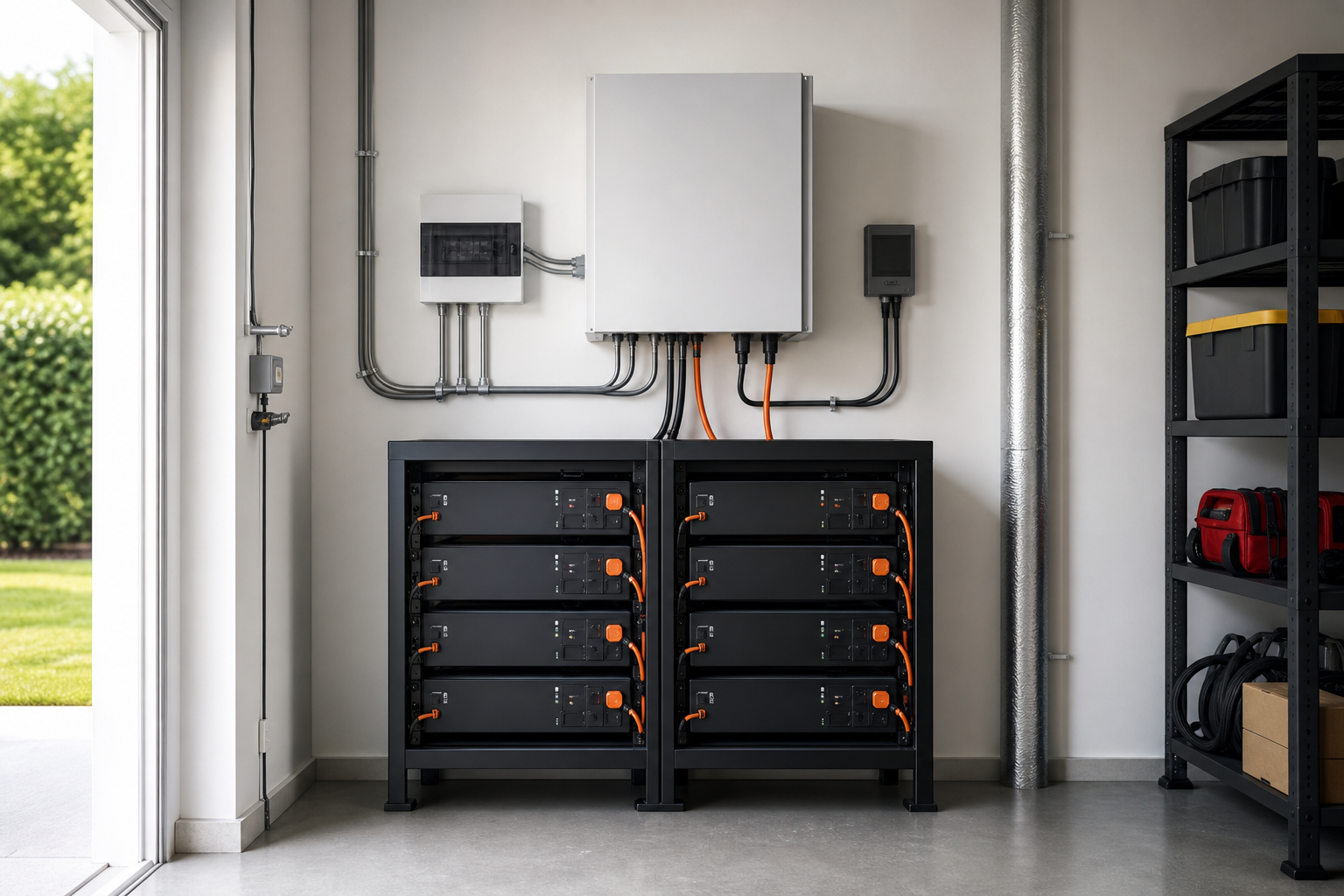
Most buyers assume that any residential battery system can serve as a whole house battery backup without solar, but mismatched sizing, missing certifications, or unclear supplier terms can lead to costly installation failures and compliance issues. This guide details the technical, certification, and sourcing checks that separate careful buyers from those who discover problems only after delivery.
What defines a whole house battery backup without solar?
A whole house battery backup without solar is an energy storage system (ESS) designed to supply all household loads during grid outages, without relying on photovoltaic (PV) input. The system must be sized to handle the home’s peak power demand and required backup duration, typically ranging from 5 kWh to over 20 kWh usable capacity. Unlike solar-coupled systems, these ESS units must recharge from the grid or generator and require a compatible inverter/charger for seamless switchover.
Key technical elements include a high-capacity lithium battery pack, a battery management system (BMS) with appropriate protections, and an inverter/charger capable of whole-home transfer. Buyers should verify that the system supports the home’s maximum instantaneous load, not just average consumption. Inadequate sizing results in nuisance shutdowns or partial backup only.
Careful buyers request a load profile analysis and confirm that the ESS can deliver the required kW output for the full backup period. Inexperienced buyers may only check kWh capacity, missing inverter limits or surge ratings.
How do I size a whole house battery backup for my application?
Sizing a whole house battery backup without solar involves three main steps: calculating total backup energy (kWh), determining peak power (kW), and matching inverter compatibility. Start by listing all essential and non-essential loads to be supported, then estimate the total energy required for the desired backup duration (e.g., 10 hours at 2 kW = 20 kWh).
Next, identify the highest simultaneous load, such as HVAC, pumps, or kitchen appliances. The battery and inverter must both support this peak power, with a safety margin for startup surges. For example, a 5 kW inverter may be insufficient if your home has a 7 kW HVAC unit.
Careful buyers ask suppliers for a table showing continuous and surge power ratings, usable capacity at 80% depth of discharge (DoD), and cycle life at that DoD. A sample procurement question: “Please provide the continuous and surge output ratings, and usable capacity at 80% DoD for your recommended ESS model.”
Which technical specifications matter most for B2B buyers?
For B2B buyers, the most critical technical specifications are usable capacity (kWh at specified DoD), cycle life (cycles at stated DoD and temperature), output power (continuous and surge), battery chemistry (LiFePO4 vs NMC), and enclosure rating (IP code for indoor/outdoor use). Each parameter should be stated with its test condition.
Below is a comparative table of typical specification ranges for residential ESS:
| Parameter | Typical Range | Test Condition |
|---|---|---|
| Usable Capacity | 5–20 kWh | 80% DoD, 25°C |
| Cycle Life | 3,000–6,000 cycles | 80% DoD, 25°C |
| Output Power | 3–10 kW | Continuous, 25°C |
| Surge Power | 5–15 kW | 10s, 25°C |
| Enclosure Rating | IP20–IP65 | IEC 60529 |
Inexperienced buyers may accept headline figures without checking test conditions, leading to overestimation of real-world performance. Always request the supplier’s full technical datasheet and clarify which figures are guaranteed versus typical.
What certifications and standards must be verified?
Certification scope is a common failure point. For whole house battery backup without solar, minimum requirements typically include IEC 62619 (cell and pack safety), UN 38.3 (transport safety), and CE (EMC and LVD) for the EU. UL 1973 or UL 9540 may be required for North America. The exact model and configuration must appear on the certificate, not just the product family.
AJPOWER, for example, lists IEC 62619 and UN 38.3 for specific residential ESS models. Buyers should request copies of certificates with the product model and serial range clearly indicated. A procurement question to paste: “Please provide IEC 62619 and UN 38.3 certificates showing the exact model and configuration quoted.”
Inexperienced buyers often accept generic certificates, which can result in customs delays, insurance refusals, or failed inspections. Always confirm the certificate scope and validity period.
How do lead times, freight, and spare parts affect project risk?
Lead time, freight classification, and spare part availability are major commercial risks for B2B buyers. Typical lead times for custom battery pack production range from 30–45 days for mass orders, with samples in 7 days. Batteries classified under UN 38.3 require special dangerous goods handling, affecting both air and sea freight schedules and costs.
AJPOWER states no overseas warehouse, so all shipments are ex-factory. Buyers should clarify Incoterms (e.g., FOB Shenzhen), confirm dangerous goods surcharges, and request a list of recommended spare parts for maintenance.
Careful buyers ask: “What is your standard lead time for the quoted configuration? Please confirm freight classification and provide a recommended spare parts list with pricing.” Inexperienced buyers may overlook these, resulting in project delays or costly emergency shipments.
What warranty and after-sales terms should be confirmed?
Warranty terms for whole house battery backup without solar typically range from 3 to 10 years, but coverage varies by supplier. Key points include cycle count, DoD, temperature range, and service response time. Some warranties exclude failures from improper installation or grid events.
Buyers should request the full warranty document and clarify claim procedures, including response time and local service options. Ask: “Please provide your full warranty terms, including cycle count, DoD, and service response time for international buyers.”
Inexperienced buyers may accept headline warranty years without reviewing exclusions or claim logistics, risking uncovered failures or long downtimes.
Which supplier checks reduce risk for international buyers?
Supplier evaluation should cover production capacity, quality control, and technical support. AJPOWER, for example, operates four automated PACK lines and employs 35 R&D staff, including BMS engineers. Buyers should request a factory audit report, sample test results, and references from similar export projects.
Critical supplier questions include:
- “Can you provide a factory audit report or recent third-party inspection?”
- “What is your process for custom battery pack design and validation?”
- “How do you support international buyers with technical troubleshooting and spare parts?”
Inexperienced buyers may skip these checks, exposing themselves to quality drift or poor after-sales support.
What are the next steps for buyers sourcing whole house battery backup without solar?
The next step is to request a technical proposal from shortlisted suppliers, specifying your required capacity, peak power, backup duration, and installation environment. Insist on full technical datasheets, certificates for the quoted configuration, and detailed warranty and after-sales terms. Compare supplier responses using a structured table of specifications, certifications, lead times, and commercial terms.
Careful buyers review all documentation before signing, reducing the risk of costly installation failures or compliance issues. If in doubt, commission a third-party technical assessment before placing a mass order.
Frequently asked questions
Can a whole house battery backup without solar be retrofitted to any home?
Most homes can be retrofitted, but electrical panel compatibility, peak load, and inverter integration must be checked. Some upgrades may be needed for older wiring or high-load appliances.
What is the difference between usable and nominal capacity in battery backup systems?
Usable capacity is the energy available at a specified depth of discharge (DoD), typically 80%. Nominal capacity is the total rated capacity, which cannot be fully used without reducing cycle life.
How do I verify if a supplier’s certification is valid for my market?
Request certificates showing your exact product model and configuration, check the issuing body, and confirm the certificate is current and covers your intended installation region.
AJPOWER-Battery