
Most installation failures trace back to mismatched BESS type and site requirements. Select the wrong enclosure or voltage, and you risk overheating, failed grid integration, or denied certification. This guide details the types of BESS, their technical differences, and how to select the right system for commercial and industrial projects.
What are the main types of BESS for commercial and industrial use?
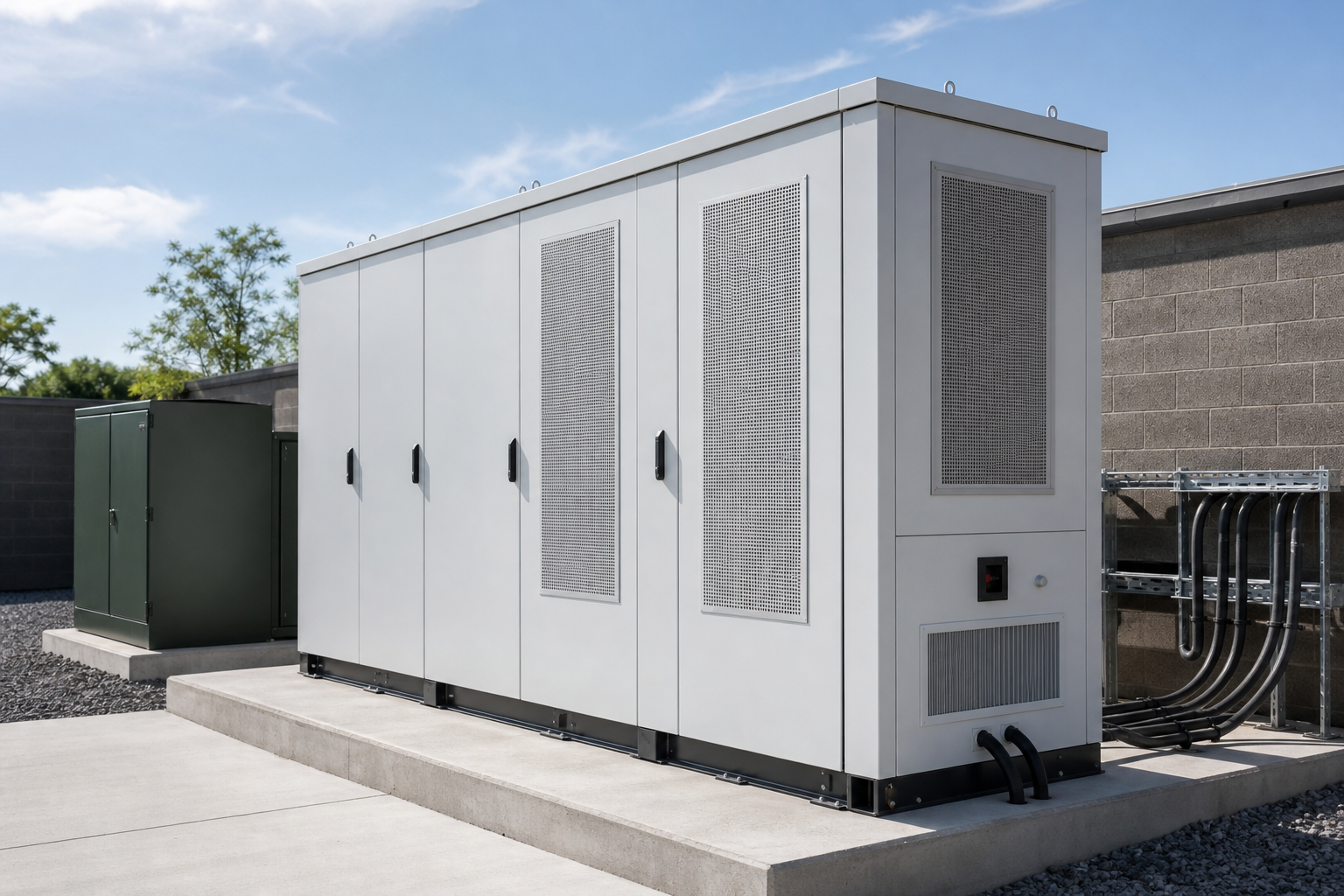
Commercial and industrial BESS types are defined by enclosure, voltage, and cooling. The three primary types are rack-mounted, cabinet, and containerized systems. Rack-mounted BESS (30–50kWh) fit 19-inch racks, use forced air cooling, and are installed indoors. Cabinet BESS (100–250kWh) use IP54/IP55 outdoor enclosures, with air or liquid cooling. Containerized BESS (500kWh–2MWh) are built in 20ft or 40ft containers, always with active HVAC or liquid cooling. Each type matches a project scale and installation environment.
Rack-mounted BESS install fastest but require a controlled indoor environment. Cabinet BESS balance outdoor durability and modularity. Containerized BESS deliver the highest capacity per footprint, but demand site preparation and grid interconnection planning.
How do enclosure and cooling methods affect BESS selection?
Enclosure rating (IP54/IP55/IP65) and cooling method (air or liquid) set the operational limits of a BESS. For IP54, expect protection against dust and splashing water, suitable for sheltered outdoor sites. IP65 enclosures resist jets of water and fine dust, used for exposed installations. Air cooling suffices for systems below 100kWh in mild climates. Liquid cooling is required above 150kWh or in ambient temperatures over 35°C, as it maintains cell temperature within ±3°C, extending cycle life and safety.
Choose liquid-cooled BESS for high-density or high-temperature sites. Air-cooled BESS cost less and are easier to maintain, but may derate in hot weather. Most commercial buyers select liquid cooling above 150kWh due to thermal stability and cycle life gains.
What technical specifications distinguish BESS types?
Voltage, capacity, and cycle life are the primary technical differentiators. Rack-mounted BESS operate at 48–51.2V, cabinets at 384–768V, and containers at 1000V or higher. Higher voltage reduces current for a given power, lowering cable size and heat loss. Cycle life depends on cell chemistry and cooling: 4000–6000 cycles at 80% DoD is typical for air-cooled LiFePO4, 7000–8000 cycles for liquid-cooled systems.
| BESS Type | Voltage | Capacity | Cooling | Cycle Life (80% DoD) |
|---|---|---|---|---|
| Rack-mounted | 48–51.2V | 30–50kWh | Air | 4000–6000 |
| Cabinet | 384–768V | 100–250kWh | Air/Liquid | 6000–8000 |
| Containerized | 1000V+ | 500kWh–2MWh | Liquid | 7000–9000 |
Which certifications and standards apply to BESS procurement?
IEC 62619 covers safety requirements for Li-ion cells and batteries in industrial applications. UL 1973 applies to stationary battery systems in North America. IEC 62477-1 addresses power electronic converter systems. For commercial BESS, require IEC 62619 and UL 1973 certificates. Request the test report by model number, not just a certificate of conformity. For grid-tied systems, check for IEC 62477-1 or equivalent.
AJPOWER’s commercial BESS models hold IEC 62619 and UL 1973 certifications, as confirmed in the company context. Always verify certification scope and validity before procurement.
How do I match BESS type to project size and application?
Project size and load profile determine the BESS type. For loads up to 30kWh, use rack-mounted BESS. For 100–250kWh, select a cabinet BESS. For 500kWh or more, containerized BESS is required. Application matters: peak shaving and backup need higher cycle life; time-shifting and grid services require high voltage and rapid response.
- Telecom backup: 10–30kWh, rack-mounted, 48V
- Commercial peak shaving: 100–250kWh, cabinet, 384–768V
- Industrial microgrid: 500kWh–2MWh, containerized, 1000V+
Always size BESS for 1.2–1.4x the daily usable energy, accounting for DoD and degradation over time.
What are the main procurement checks for BESS selection?
Request a full specification sheet with voltage, capacity, cycle life, enclosure rating, cooling method, and certifications. Ask for a typical system layout and installation manual. Confirm the BESS can interface with your inverter and site voltage. For commercial orders, require a sample test (7 days for AJPOWER) and clarify lead time (30–45 days for mass production). Minimum order is 10 units for most suppliers.
Compare suppliers by dividing the quoted price by the rated cycle count to estimate cost per cycle. Always match the specification (e.g., 384V 280Ah, IP54, 6000 cycles) when comparing offers.
What installation and maintenance factors differ by BESS type?
Rack-mounted BESS install in IT racks, with simple wiring and minimal cooling needs. Cabinet BESS require outdoor-rated pads, weatherproof cable entry, and periodic air filter cleaning. Containerized BESS need crane placement, HVAC commissioning, and grid protection relay setup. Liquid-cooled systems add coolant checks and pump maintenance to the schedule.
Maintenance intervals: air-cooled BESS require quarterly filter checks; liquid-cooled BESS need biannual coolant inspection. Most failures trace to neglected cooling or improper enclosure sealing. Always follow the supplier’s maintenance manual for each BESS type.
What is the next step in BESS procurement?
Review your project’s daily load, installation environment, and grid requirements. Request technical datasheets and certification reports from suppliers. Confirm compatibility with your inverter and site voltage. For commercial projects, arrange a sample test and verify certification scope before placing a mass order.
Frequently asked questions
How do I choose between air-cooled and liquid-cooled BESS?
Use air-cooled BESS for systems below 100kWh in mild climates. Select liquid-cooled BESS above 150kWh or for sites with ambient temperature above 35°C, as it maintains tighter cell temperature control and extends cycle life.
What is the minimum order quantity for commercial BESS?
For AJPOWER, the minimum order quantity is 10 units. Always confirm MOQ with each supplier, as it may vary by model and customization level.
Which standards are essential for commercial BESS certification?
Require IEC 62619 for cell and battery safety, UL 1973 for stationary systems, and IEC 62477-1 for power electronics. Always request the actual test report by model number.
AJPOWER-Battery