
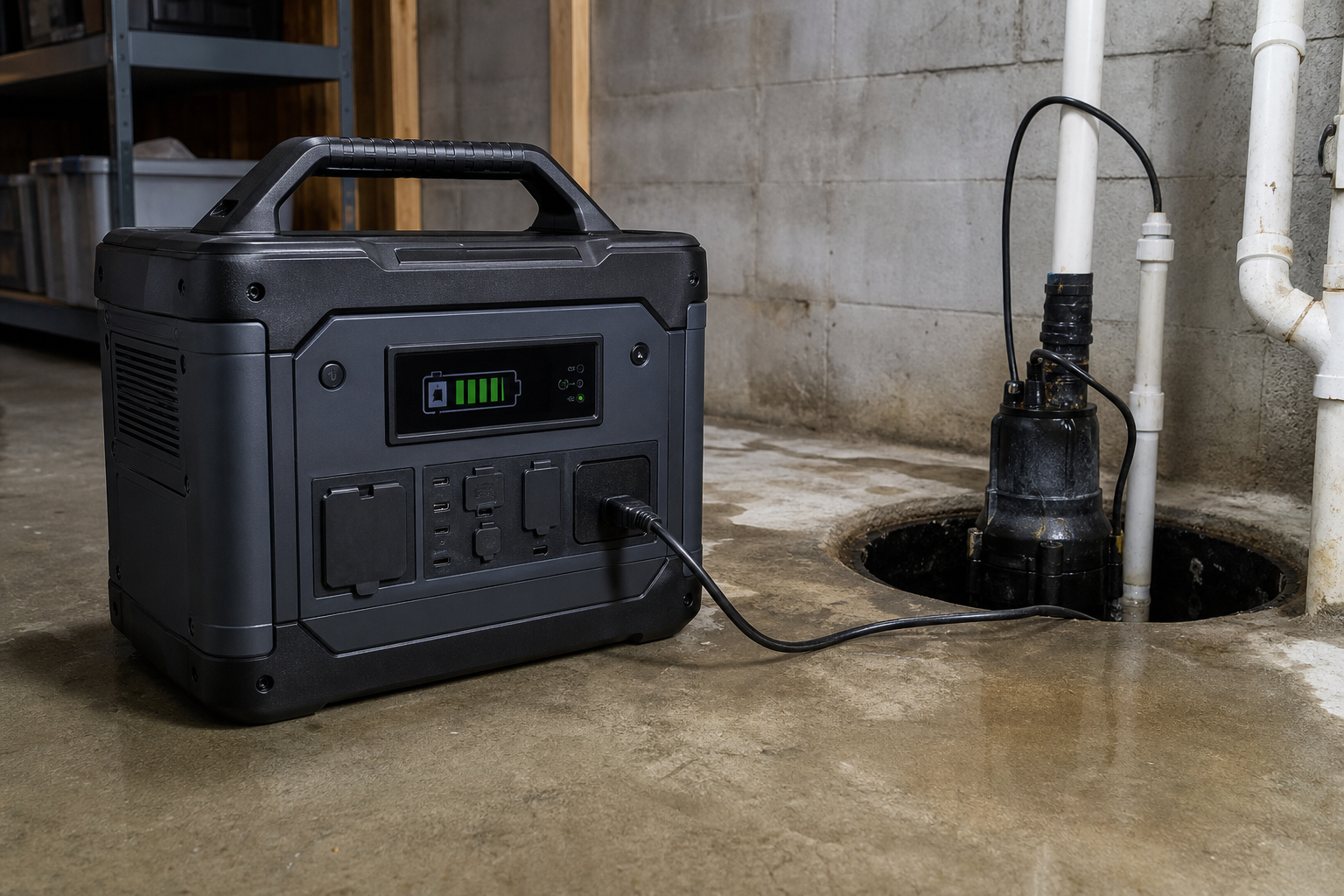
Most sump pump failures during outages are caused by undersized backup power. A portable power station for sump pump backup must deliver both the surge and sustained power required by the pump motor. This guide explains how to size, select, and specify a portable power station for sump pump applications in commercial and industrial settings.
How do I calculate the power requirements for a sump pump?
Start with the pump’s rated power. A typical 1/2 HP sump pump draws 373W (1 HP = 746W; 0.5 × 746 = 373W) under ideal conditions. Actual running power is usually 700–900W due to motor inefficiency and load. Startup surge can reach 2.5–3× running power: for 800W running, expect 2,000–2,400W surge. Always size the inverter for the surge, not just the running load.
Check the pump nameplate for rated amps and voltage. For example, 120V, 9A running = 1,080W (120 × 9). If the pump cycles frequently, use the higher value. Document both running and surge requirements for procurement.
What battery capacity is needed for backup runtime?
Required battery capacity = running power × desired runtime ÷ inverter efficiency. For a 1/2 HP pump running 800W for 3 hours at 90% inverter efficiency: 800 × 3 ÷ 0.9 = 2,667Wh. At 80% depth of discharge (DoD), usable capacity = total capacity × 0.8, so specify at least 3.3 kWh total capacity (2,667 ÷ 0.8).
For multiple pumps or longer runtime, multiply accordingly. Always confirm the usable (not just nominal) capacity with the supplier. Lithium iron phosphate (LiFePO4) batteries typically allow 80–90% DoD, but verify the cycle life at the stated DoD.
Which inverter specifications are critical for sump pump operation?
Pure sine wave output is mandatory for pump motors. Modified sine wave inverters cause overheating and early failure. Inverter continuous rating must meet or exceed the pump’s running power. Surge rating must cover the startup (2.5–3× running power).
For a 1/2 HP pump at 800W running, specify a portable power station with at least 2,400W surge and 1,000W continuous AC output. Confirm the surge duration (typically 2–5 seconds) matches the pump’s startup profile. List both continuous and surge ratings in procurement documents.
How do I check compatibility between the portable power station and the sump pump?
Match the AC output voltage and frequency to the pump’s requirements. North American pumps use 120V/60Hz; European models use 230V/50Hz. Some portable power stations offer selectable output; others are fixed.
Check the outlet type and maximum load per outlet. For pumps with plug-in cords, confirm the power station’s socket matches. For hardwired pumps, use a qualified electrician to connect via a transfer switch or junction box.
What procurement specifications should B2B buyers include?
Include these parameters in the RFQ or purchase order:
- AC output voltage, frequency, and waveform (pure sine wave)
- Continuous and surge power ratings (W)
- Battery chemistry (LiFePO4 preferred for cycle life and safety)
- Total and usable battery capacity (Wh or kWh at stated DoD)
- Cycle life at specified DoD
- Enclosure IP rating (minimum IP54 for damp locations)
- Operating temperature range
- Certifications (IEC 62133, UL 1973, or local equivalents)
Request a technical data sheet with all values stated under test conditions. For custom battery pack solutions, specify connector type and cable length.
How do portable power stations compare to other backup options?
Portable power stations are self-contained, require no installation, and can be redeployed. Generator sets offer longer runtime but require fuel, maintenance, and ventilation. UPS backup systems provide seamless switchover but are typically fixed installations.
| Backup Type | Setup | Runtime | Maintenance | Noise |
|---|---|---|---|---|
| Portable Power Station | Plug-and-play | 1–6 hours | Low | Silent |
| Generator Set | Installed | Unlimited (fuel) | High | Loud |
| UPS Backup | Installed | Minutes–hours | Medium | Silent |
For short to medium outages, portable power stations win on flexibility and ease of deployment. For critical sites needing days of backup, generator sets are still required.
What installation and maintenance checks are required?
Portable power stations require minimal installation. Place the unit on a level, dry surface. Ensure ventilation is adequate for cooling. Do not operate in standing water or direct rain unless the enclosure is rated IP65 or higher.
Test the system monthly by running the pump from the power station for at least one full cycle. Recharge the battery after each use. For LiFePO4 packs, expect 2,000–6,000 cycles at 80% DoD. Replace the battery when capacity falls below 70% of nominal.
What are the main failure modes and how can they be prevented?
Common failures include inverter overload (undersized for surge), battery depletion (insufficient capacity), and connector faults. Prevent these by sizing for worst-case surge, specifying usable capacity, and using industrial-grade connectors.
Monitor battery state of charge during outages. If the power station shuts down before the pump cycle completes, increase capacity or reduce runtime expectations. Document all test results and maintenance actions for warranty and compliance.
Frequently asked questions
How do I calculate the minimum battery size for a 1/2 HP sump pump?
Multiply the running power (typically 800W) by the required runtime (hours), divide by inverter efficiency (e.g., 0.9), then divide by usable DoD (e.g., 0.8). For 3 hours: 800 × 3 ÷ 0.9 ÷ 0.8 = 3,333Wh total capacity.
Can I use a modified sine wave inverter with a sump pump?
No. Sump pump motors require pure sine wave AC output. Modified sine wave inverters cause overheating, noise, and early failure of the pump motor.
What IP rating is needed for a portable power station in a basement?
Use at least IP54 for damp basements. For areas with risk of direct water spray or flooding, specify IP65 or higher to protect against water ingress.
AJPOWER-Battery