
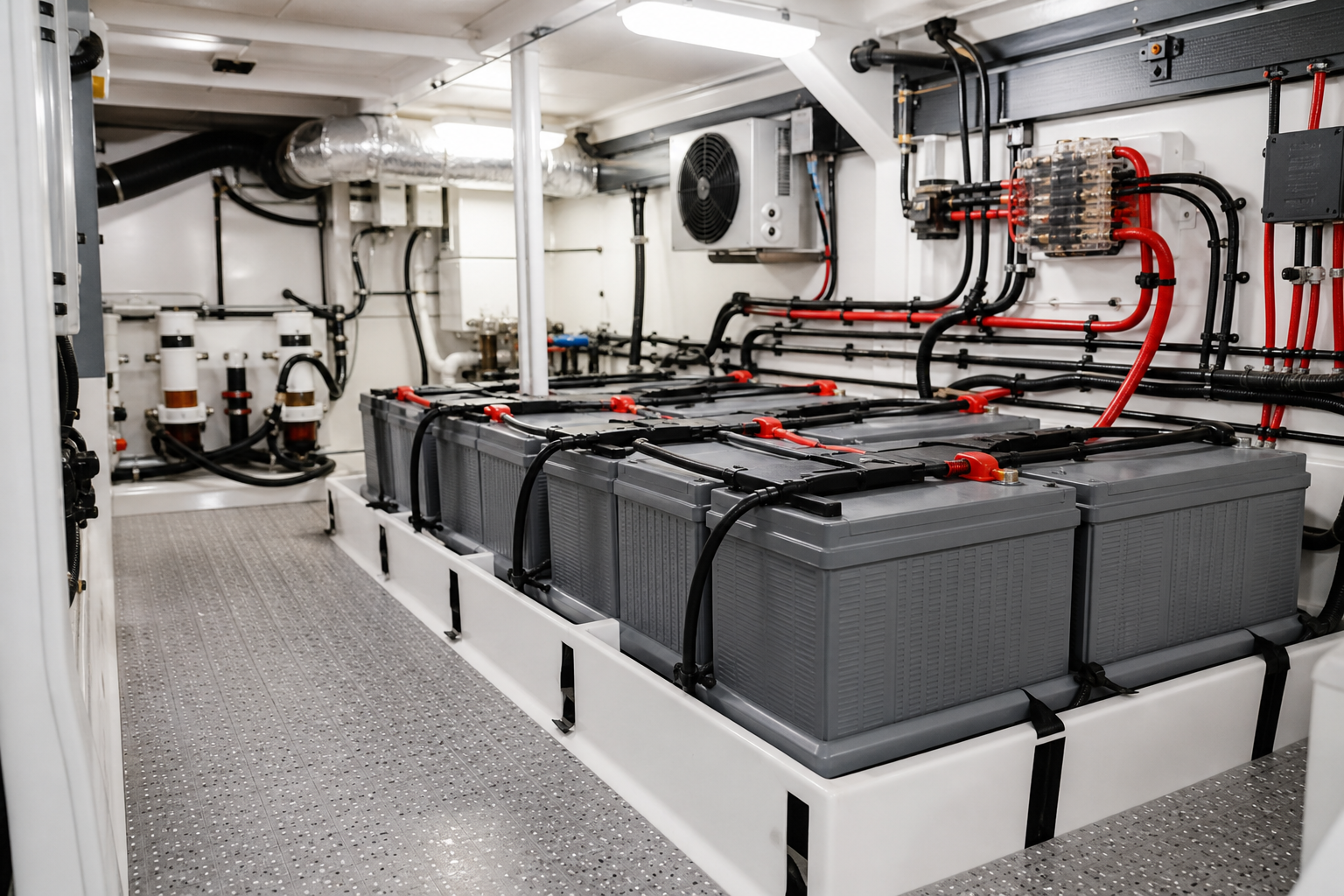
Most buyers assume an AGM marine battery will last as long as the datasheet claims, but in the field, installation errors and overlooked site conditions cut that life short. If you’ve ever pulled a swollen, overheated battery from a tight engine room, you know the cost of getting it wrong. This guide covers what spec sheets leave out: real-world sizing, installation, and procurement checks for AGM marine batteries in industrial and commercial marine applications.
What is an AGM marine battery and how does it work?
An AGM marine battery is a valve-regulated lead-acid (VRLA) battery that uses Absorbent Glass Mat separators to immobilize the electrolyte. This design prevents acid spills and allows for flexible mounting orientation, making it popular in marine and industrial settings. The AGM construction also means lower internal resistance, so you get higher discharge rates compared to flooded lead-acid batteries, but with less maintenance.
In practical terms, AGM marine batteries are sealed, so you don’t top up water. They vent only under severe overcharge or fault. The glass mat holds the acid in place, so vibration and tilt from vessel motion don’t cause stratification or leakage. However, they’re sensitive to overcharging and high temperatures, which can dry out the mat and shorten service life.
How do you size an AGM marine battery for industrial marine use?
Undersizing is the most common failure I see. If you install an AGM marine battery that’s too small for the load or discharge rate, expect early capacity loss and heat buildup. Always size based on the maximum sustained load, not just average draw. For critical systems, add a 20–25% margin above calculated amp-hour needs to account for aging and real-world inefficiencies.
Cycle life is also tied to depth of discharge (DoD). Most AGM marine batteries are rated for 400–600 cycles at 80% DoD, but if you regularly discharge deeper, expect fewer cycles. Check the manufacturer’s cycle life curve, not just the headline figure. For parallel installations, ensure cable lengths are equal to balance current draw between batteries.
| Parameter | Typical Range | Measurement Condition |
|---|---|---|
| Nominal Voltage | 12V, 24V | Standard cell configuration |
| Capacity | 50–200Ah | 20-hour rate at 25°C |
| Cycle Life | 400–600 cycles | 80% DoD, 25°C |
| Max Discharge Current | 5–10x Ah rating | Short bursts, 5 sec |
What installation pitfalls cause AGM marine battery failures?
The most frequent failures I see are due to poor ventilation and cramped cable runs. AGM marine batteries generate heat under load and charging. If you install them in a confined locker with no airflow, internal temperatures climb, cutting cycle life by 15–20% for every 10°C above 25°C. Always allow at least 50 mm clearance on all sides for airflow and service access.
Another problem is cable routing. Tight bends or undersized cables cause voltage drop and uneven charging. Use marine-grade cables sized for the maximum current, and avoid running cables near heat sources. Secure all connections with torque to the manufacturer’s spec—loose terminals cause arcing and heat.
- Allow 50 mm minimum clearance around each battery.
- Use cable lugs sized for the terminal post.
- Label cables for polarity and circuit ID.
How does ambient temperature affect AGM marine battery performance?
Ambient temperature is the silent killer of AGM marine batteries. Every 10°C rise above 25°C reduces battery life by 15–20%. In engine rooms or sun-exposed lockers, it’s common to see batteries running at 35–40°C. That cuts a 500-cycle battery down to 300–350 cycles in practice.
To mitigate this, install batteries away from heat sources and insulate against radiant heat where possible. If you can’t avoid high temperatures, consider derating the battery capacity and cycle life in your calculations. Some buyers specify forced ventilation or cooling for high-capacity banks, but even passive airflow makes a difference.
What should you check on an AGM marine battery spec sheet?
Spec sheets are useful, but they rarely tell the whole story. Always check the rated capacity at the 20-hour rate and the cycle life at 80% DoD and 25°C. If the spec sheet only gives a single cycle life figure, ask for the full cycle life curve. Look for the maximum charge and discharge current ratings, and confirm the recommended float and absorption voltages.
Compare self-discharge rates—AGM marine batteries typically lose 2–3% per month at 25°C, but this rises with temperature. If you see a battery rated for much lower self-discharge, check the test conditions. For parallel installations, confirm that the manufacturer supports this configuration and provides balancing guidance.
How do you compare AGM marine battery suppliers for B2B procurement?
Comparing AGM marine battery suppliers is not just about headline price. Have each supplier quote the same voltage, amp-hour, and cycle life at 80% DoD. Then, divide the quoted price by the rated cycle count to get a cost-per-cycle figure. This levels the field and exposes hidden differences in cycle life or usable capacity.
Ask for documentation of compliance with IEC 60896-21/22 or UL 1989 if your application requires it. Check for batch traceability and production date codes—older stock may have lost capacity in storage. Finally, request references for similar marine or industrial installations, not just generic product lists.
| Supplier | Voltage | Capacity (Ah) | Cycle Life (80% DoD) | Cost per Cycle |
|---|---|---|---|---|
| Supplier A | 12V | 120 | 500 | Ask for quote |
| Supplier B | 12V | 120 | 600 | Ask for quote |
What maintenance and service access do AGM marine batteries require?
AGM marine batteries are marketed as maintenance-free, but that doesn’t mean you can ignore them. In the field, I see most failures from poor access: batteries buried behind panels or under deck plates. Plan for regular visual inspection—look for swelling, corrosion, or loose terminals. Allow enough clearance to remove and replace batteries without disconnecting half the system.
Check terminal torque and cable condition every six months. Clean terminals with a non-metallic brush and apply dielectric grease to prevent corrosion. If you see white residue or acid smell, investigate immediately—these are signs of overcharge or internal fault.
- Schedule six-monthly inspections for all battery banks.
- Keep a log of installation date, cycle count, and service actions.
- Replace batteries in matched sets to avoid imbalance.
What are the main differences between AGM marine batteries and other marine battery types?
AGM marine batteries differ from flooded lead-acid and gel batteries in several ways. Unlike flooded types, AGMs are sealed and spill-proof, so they can be mounted in any orientation. Compared to gel batteries, AGMs offer higher discharge rates and tolerate vibration better, but are more sensitive to overcharging.
Lithium battery packs (LiFePO4) are gaining ground for marine use due to longer cycle life (2000–4000 cycles at 80% DoD) and lighter weight. However, they require a battery management system and have stricter charging requirements. AGM remains a practical choice for buyers who need proven technology, moderate cost, and straightforward installation.
| Type | Cycle Life (80% DoD) | Maintenance | Mounting |
|---|---|---|---|
| AGM | 400–600 | Low | Any orientation |
| Flooded | 250–400 | Regular water top-up | Upright only |
| Gel | 500–700 | Low | Any orientation |
| Lithium (LiFePO4) | 2000–4000 | Very low | Any orientation |
Before you place an order, review your installation site for clearance, cable routing, and temperature exposure. Confirm that your supplier quotes the same technical specification and provides full cycle life data. If you’re unsure, request a technical assessment to avoid costly installation errors.
Frequently asked questions
Can AGM marine batteries be installed on their side or upside down?
Yes, AGM marine batteries can be installed on their side or even upside down because the electrolyte is immobilized in the glass mat. However, always follow the manufacturer's mounting guidelines and ensure terminals are accessible for service.
How do you calculate the correct cable size for AGM marine battery installations?
Calculate cable size based on the maximum expected current and the total cable run length. Use marine-grade copper cable, and refer to ABYC E-11 or IEC 60364-7-709 tables for ampacity and voltage drop limits. Undersized cables cause voltage drop and overheating.
What is the typical self-discharge rate for AGM marine batteries during storage?
AGM marine batteries typically self-discharge at 2–3% per month at 25°C. Higher ambient temperatures increase this rate. For long-term storage, disconnect loads and recharge every 3–6 months to prevent deep discharge.
AJPOWER-Battery