
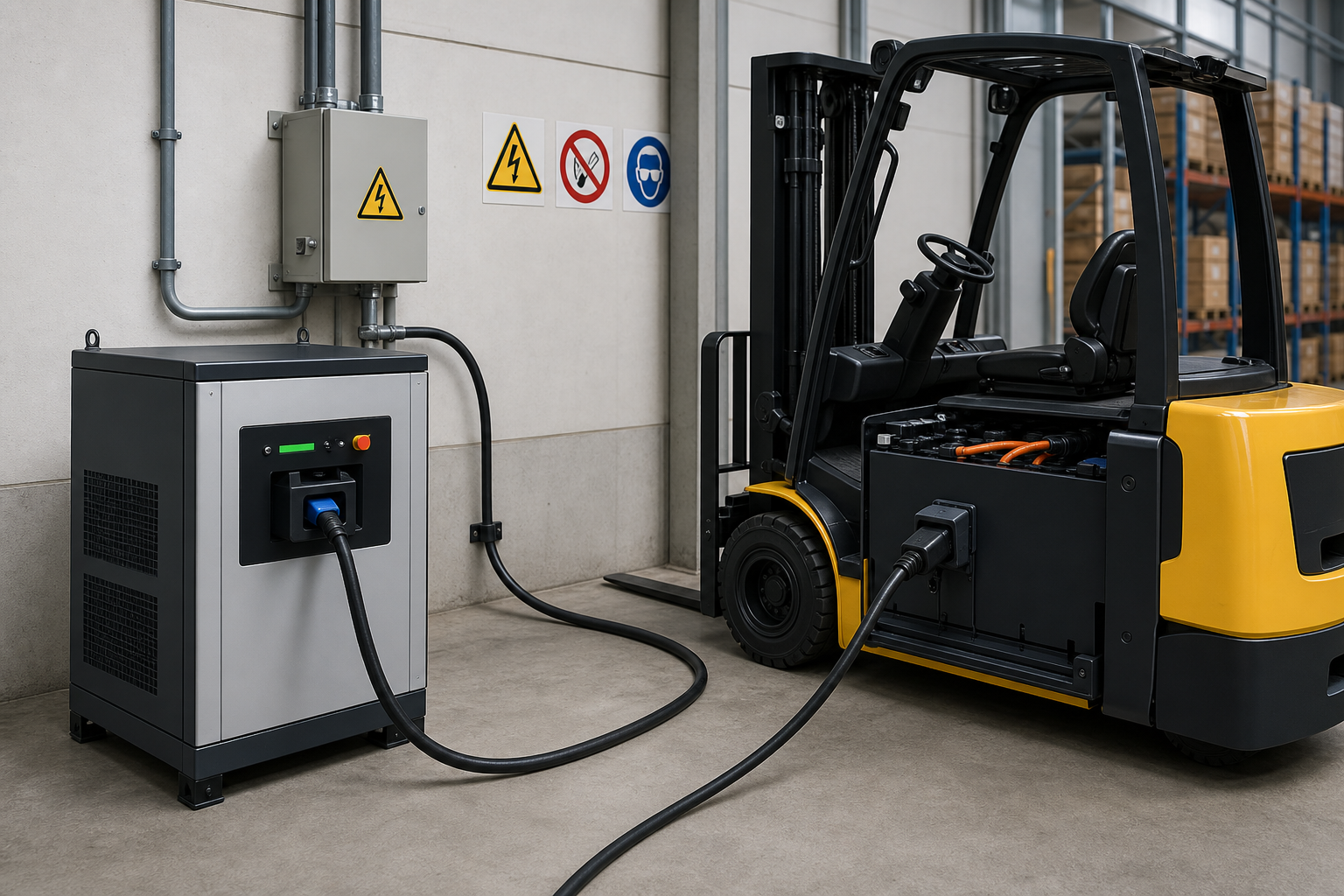
Choosing a fork truck battery charger without matching it to your battery and site can cost months of lost productivity and thousands in avoidable battery replacements. Many buyers assume any charger rated for the right voltage will work, but mismatched current, plug type, or grid compatibility can void warranties and halt operations. This guide addresses the technical and commercial risks installers and distributors face, and gives you the language and checks to defend your procurement decisions.
What are the key technical specifications for a fork truck battery charger?
The most critical specifications for a fork truck battery charger are output voltage, output current, charging algorithm, and compatibility with battery chemistry. Output voltage must match the nominal voltage of the battery within ±5%. For example, a 48V lithium battery requires a charger set precisely for 51.2V nominal, not a generic 48V lead-acid charger. Output current is typically sized at 15–25% of the battery’s amp-hour rating for standard shift operations. Charging algorithms must be compatible with the battery’s chemistry—LiFePO4 batteries require different profiles from lead-acid, and using the wrong one can reduce battery life by 20–40% over 2–3 years.
Always confirm the charger’s plug type and communication protocol (such as CAN bus or Modbus) match the battery’s BMS. Incompatibility here can prevent charging or disable safety features. For multi-shift operations, consider fast chargers, but note the increased thermal load and the need for enhanced ventilation.
Key charger specifications to confirm:
- Output voltage (V) and current (A)
- Charging profile (algorithm)
- Plug/connector type
- Communication protocol
- Input voltage and frequency
How do I size a fork truck battery charger for my application?
Sizing a fork truck battery charger starts with the battery’s amp-hour (Ah) rating and the operational shift pattern. For a single-shift operation, a charger outputting 15–20% of the battery’s Ah rating per hour is typical. For example, a 460Ah battery would pair with a 70–90A charger. Multi-shift or opportunity charging may require up to 30–40% of the Ah rating, but this increases heat and may shorten battery life if not managed.
Use this formula to estimate charge time:
- Charge Time (hours) = Battery Capacity (Ah) / Charger Output (A) × 1.2 (for efficiency losses)
Always check the battery manufacturer’s recommended charge rate. Oversizing the charger can void warranties, while undersizing leads to incomplete charging and lost productivity. For lithium batteries, confirm the charger’s maximum current matches the BMS limit.
What are the main compatibility risks with fork truck battery chargers?
The most common compatibility risks are mismatched voltage, current, plug type, and communication protocol. A charger set for the wrong voltage can trigger BMS protection or cause permanent battery damage. Using a charger with a higher current than the battery’s BMS allows can result in thermal runaway or premature aging.
Plug and connector mismatches are frequent in international procurement. For example, DIN connectors are standard in Europe, while Anderson or SB types are common in North America. Confirm both the plug type and pinout before shipment. Communication protocol mismatches (such as CAN bus vs. Modbus) can prevent the charger from reading battery status or enabling safety interlocks.
Compatibility checklist:
- Voltage and current match
- Plug/connector type
- Communication protocol
- Grid input voltage/frequency
- Physical dimensions for installation
Which installation environment factors affect charger performance and safety?
Ambient temperature, ventilation, and grid stability are the primary environmental factors affecting fork truck battery charger performance. Most chargers are rated for 0–40°C operation; exceeding this range can reduce charging efficiency or trigger thermal cutoffs. Poor ventilation increases heat buildup, especially with fast chargers, and can shorten both charger and battery life.
Grid voltage fluctuations or harmonics can cause charger faults or reduce charging efficiency. In regions with unstable grids, consider chargers with built-in surge protection or voltage regulation. Mounting location should allow at least 30cm clearance around the charger for airflow and maintenance access.
Environmental factors to check:
- Ambient temperature range
- Ventilation and airflow
- Grid voltage and frequency stability
- Ingress protection (IP) rating
How do I compare charger options for different battery chemistries?
Fork truck battery chargers must be matched to the battery chemistry—lead-acid, LiFePO4, or nickel-based. Each chemistry requires a specific charging profile. For example, LiFePO4 batteries use a constant current/constant voltage (CC/CV) profile, while lead-acid chargers often include equalization stages. Using a lead-acid charger on a lithium battery can reduce cycle life by 30% or more.
Compare charger options using a table of key parameters:
| Battery Chemistry | Charger Profile | Typical Output Voltage | Cycle Life Impact |
|---|---|---|---|
| Lead-Acid | Multi-stage (bulk/abs/equalize) | 12V/24V/48V | Normal if matched |
| LiFePO4 | CC/CV, no equalize | 12.8V/25.6V/51.2V | 20–40% loss if mismatched |
| Nickel-based | Custom, temp-sensitive | Varies | High risk if mismatched |
Always request the charger manufacturer’s compatibility statement for your battery chemistry. For mixed fleets, consider dual-profile chargers, but confirm with both battery suppliers before purchase.
What procurement checks prevent shipment delays and warranty disputes?
Procurement errors with fork truck battery chargers most often arise from incomplete specification sheets, mismatched plug types, or missing certifications. Always require a full technical datasheet, including output voltage, current, plug type, and supported protocols. Request a sample plug or photo to confirm connector compatibility before bulk order.
Check grid input voltage and frequency for the destination site. European sites typically use 230V/50Hz, while North America uses 120V/60Hz or 208–240V/60Hz. Ordering the wrong input type can delay projects by weeks. If your site requires CE, UL, or other certification, specify this in the purchase order and request a copy of the certificate before shipment.
Procurement checklist:
- Full technical datasheet
- Plug/connector confirmation
- Input voltage/frequency match
- Required certifications
- Physical dimensions and mounting
How do I evaluate suppliers for fork truck battery chargers?
Supplier evaluation should focus on technical support, documentation quality, and after-sales service. Ask for references from similar projects and review the supplier’s response time to technical queries. Documentation should include wiring diagrams, installation manuals, and a clear warranty statement.
For international orders, confirm the supplier’s experience with export documentation and customs clearance. Delays often occur when suppliers are unfamiliar with destination country requirements. If possible, request a pre-shipment inspection or factory acceptance test (FAT) report.
Supplier evaluation criteria:
- Technical support responsiveness
- Quality of documentation
- Export experience
- Warranty and service terms
What is the next step before placing a charger order?
Before placing a fork truck battery charger order, review the battery and charger specifications side by side, confirm all plug and protocol matches, and request written confirmation from the supplier. For complex installations or mixed fleets, consider a technical assessment from an independent engineer or the battery manufacturer. This step can prevent costly errors and shipment delays.
Document all requirements in the purchase order and keep a record of supplier confirmations. This provides a defensible position if disputes arise later. For large projects, schedule a pre-installation meeting with all stakeholders to review site requirements and delivery timelines.
Frequently asked questions
Can I use a lead-acid charger for a lithium fork truck battery?
No. Using a lead-acid charger on a lithium battery, such as LiFePO4, can reduce battery life by 20–40% and may void the battery warranty. Always use a charger with the correct charging profile.
What happens if the charger output current is too high for my battery?
If the charger output current exceeds the battery's BMS limit, it can cause overheating, trigger protection circuits, or permanently damage the battery. Always match the charger to the battery's rated charge current.
How do I confirm plug and connector compatibility before ordering?
Request a sample plug or detailed photo from the supplier, and compare it to your battery's connector. Confirm pinout and locking mechanism to avoid shipment delays or installation errors.
AJPOWER-Battery