
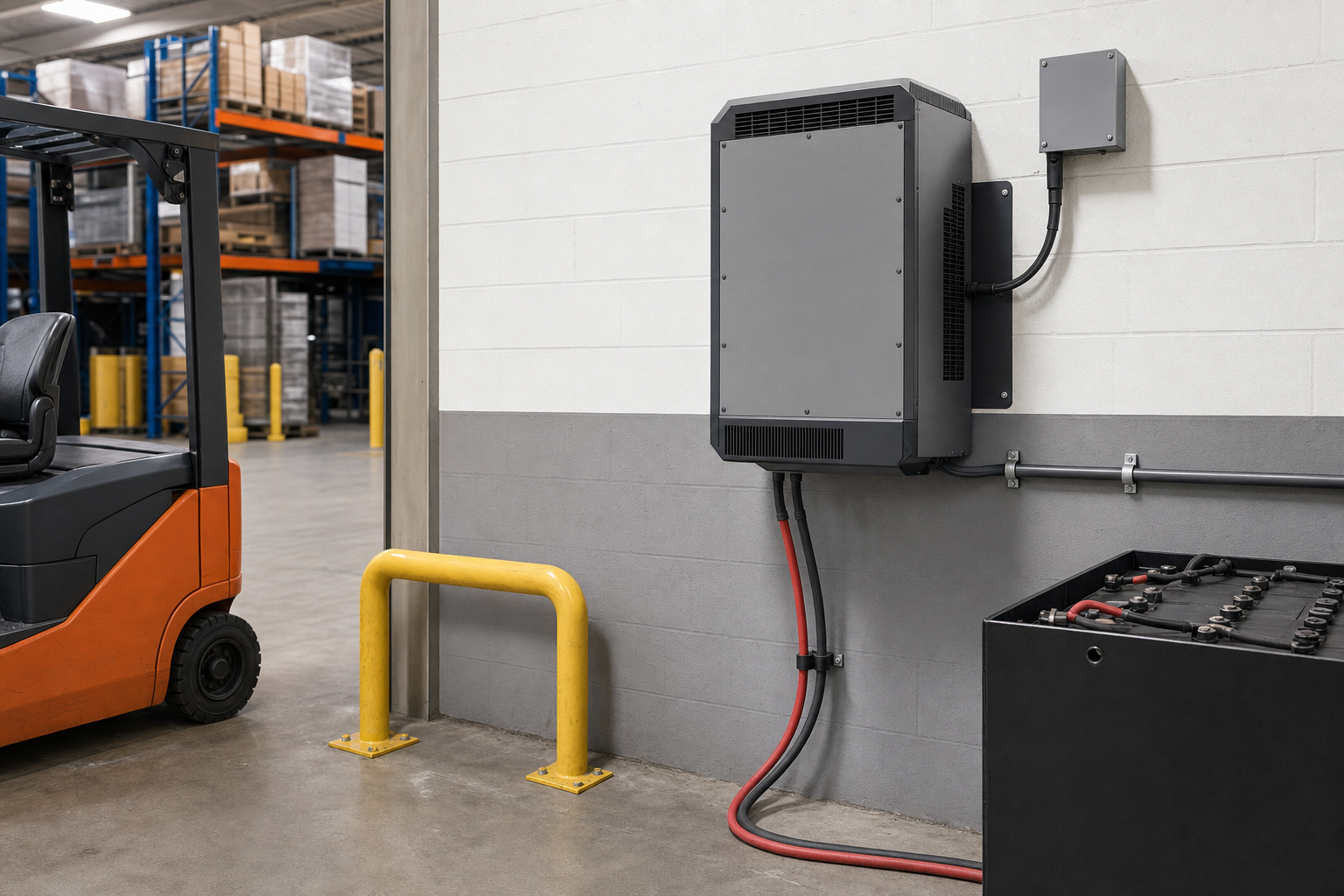
Most forklift battery charger failures I see aren’t from the charger itself—they’re from poor installation or mismatched specifications. If you’re buying for a new site or replacing a charger, you need to look beyond the spec sheet. Cost, lead time, and certification all matter, but so do cable runs, ambient temperature, and service access. Here’s what actually goes wrong, and how to avoid it.
What drives the cost of a forklift battery charger?
The main cost drivers for a forklift battery charger are output voltage, maximum charging current, and required certifications. Higher voltage or current ratings mean heavier transformers and more robust components, which push up both material and shipping costs. If you need a charger for a 48V 460Ah battery, expect a different price than for a 24V 210Ah unit, even before you add certification.
Certification adds another layer. UL 1564 (for North America) or IEC 62040 (for international) compliance requires specific components, documentation, and sometimes third-party testing. That can add 10–30% to the unit cost, depending on the certification body and the charger’s complexity. Always ask suppliers to quote the same voltage, current, and certification scope, then divide the quote by the rated cycle count to compare cost per cycle.
- Voltage and current rating (e.g., 24V 80A vs. 48V 100A)
- Certification (UL, IEC, CE)
- Custom features (CAN bus, remote monitoring, special plugs)
- Order volume and shipping method
How long is the typical lead time for a forklift battery charger?
Lead time for a forklift battery charger is usually 6–14 weeks from order to delivery, depending on certification and customization. The biggest delays come from certification testing and custom cable assemblies. If you need a charger with non-standard connectors or cable lengths, add 2–4 weeks to the quoted lead time.
For standard models with no special requirements, some suppliers keep stock, but most B2B buyers will be quoted a build-to-order lead time. Always confirm the lead time in writing, and ask if the quoted time includes certification, cable assembly, and factory acceptance testing.
| Specification | Standard Lead Time | With Certification | With Custom Cables |
|---|---|---|---|
| 24V/48V, 80–100A | 6–8 weeks | 8–12 weeks | 10–14 weeks |
| 80V, 100–150A | 8–10 weeks | 10–14 weeks | 12–16 weeks |
Which certifications are required for forklift battery chargers?
For most industrial buyers, the forklift battery charger must comply with either UL 1564 (North America), IEC 62040 (Europe/Asia), or local equivalents. These standards cover electrical safety, electromagnetic compatibility, and sometimes environmental testing. Insurance and site safety audits often require documented compliance, not just a CE mark.
Don’t assume a CE mark alone is enough—many insurers and local authorities want a full test report. If you’re exporting, check the destination country’s requirements before ordering. For multi-site operations, standardize on the strictest requirement to avoid future headaches.
- UL 1564: Industrial battery chargers (North America)
- IEC 62040: Uninterruptible power systems (Europe/Asia)
- EN 61000: Electromagnetic compatibility (EU)
What installation failures cause forklift battery charger problems?
The most common failures I see are from poor installation, not bad hardware. Chargers need at least 200–300 mm clearance on all sides for airflow. Installers often ignore this, especially in tight warehouse corners, leading to overheating and early failure. Ambient temperature above 35°C can also derate the charger’s output—check the datasheet for the derating curve.
Cable runs longer than 5 meters need heavier gauge wire to avoid voltage drop. Undersized cables cause slow charging and can trip the charger’s protection circuits. Always measure your actual cable path, not just the straight-line distance, and specify cable gauge accordingly.
- Minimum clearance: 200–300 mm for airflow
- Ambient temperature: derate above 35°C
- Cable length: increase gauge above 5 meters
- Service access: allow space for maintenance and inspection
How do I match a forklift battery charger to my battery?
Matching a forklift battery charger to your battery means more than just voltage. You need to check the battery’s rated capacity (Ah), chemistry (lead-acid or lithium), and recommended charge profile. For example, a 48V 460Ah lithium battery requires a charger with a compatible charge algorithm and CAN bus support for BMS communication.
Charging current should be 10–20% of the battery’s rated capacity for standard shift operations. For fast charging, you may go up to 40%, but only if the battery and charger are both rated for it. Always confirm charger compatibility with your battery supplier, especially for lithium systems.
| Battery Type | Voltage | Capacity (Ah) | Recommended Charger Current |
|---|---|---|---|
| Lead-acid | 24V | 210 | 21–42A |
| Lithium (LiFePO4) | 48V | 460 | 46–92A |
| Heavy-duty lithium | 80V | 600 | 60–120A |
What should I ask suppliers before ordering a forklift battery charger?
Before placing an order, ask suppliers for a full technical datasheet, certification documents, and a wiring diagram. Confirm the charger’s compatibility with your battery chemistry and BMS. Request a breakdown of lead time by manufacturing, certification, and shipping. If you need custom cable lengths or connectors, specify them in writing and ask for a revised lead time.
Ask for a list of recommended spare parts and maintenance intervals. If your site has high ambient temperatures or dust, ask about derating and environmental protection. Finally, request a factory acceptance test report if you’re buying multiple units or for a critical application.
- Technical datasheet (voltage, current, charge profile)
- Certification documents (UL, IEC, CE)
- Wiring diagram and connector details
- Lead time breakdown and spare parts list
Review your forklift battery and charger specifications side by side. Confirm certification, cable routing, and installation conditions before placing your order. If you’re unsure, request a technical assessment from your battery or charger supplier to avoid costly mistakes.
Frequently asked questions
Can I use a lead-acid charger for a lithium forklift battery?
No. Lithium batteries require a charger with a compatible charge profile and, often, CAN bus communication for battery management. Using a lead-acid charger risks battery damage and voids warranties.
How do I calculate the correct cable size for my forklift battery charger?
Calculate the total cable length from charger to battery, then use a voltage drop table for your current. For runs over 5 meters, increase cable gauge to keep voltage drop below 3%.
What happens if my charger lacks the required certification?
Lack of certification can lead to failed safety audits, denied insurance claims, and legal issues. Always confirm UL, IEC, or local compliance before installation.
AJPOWER-Battery