
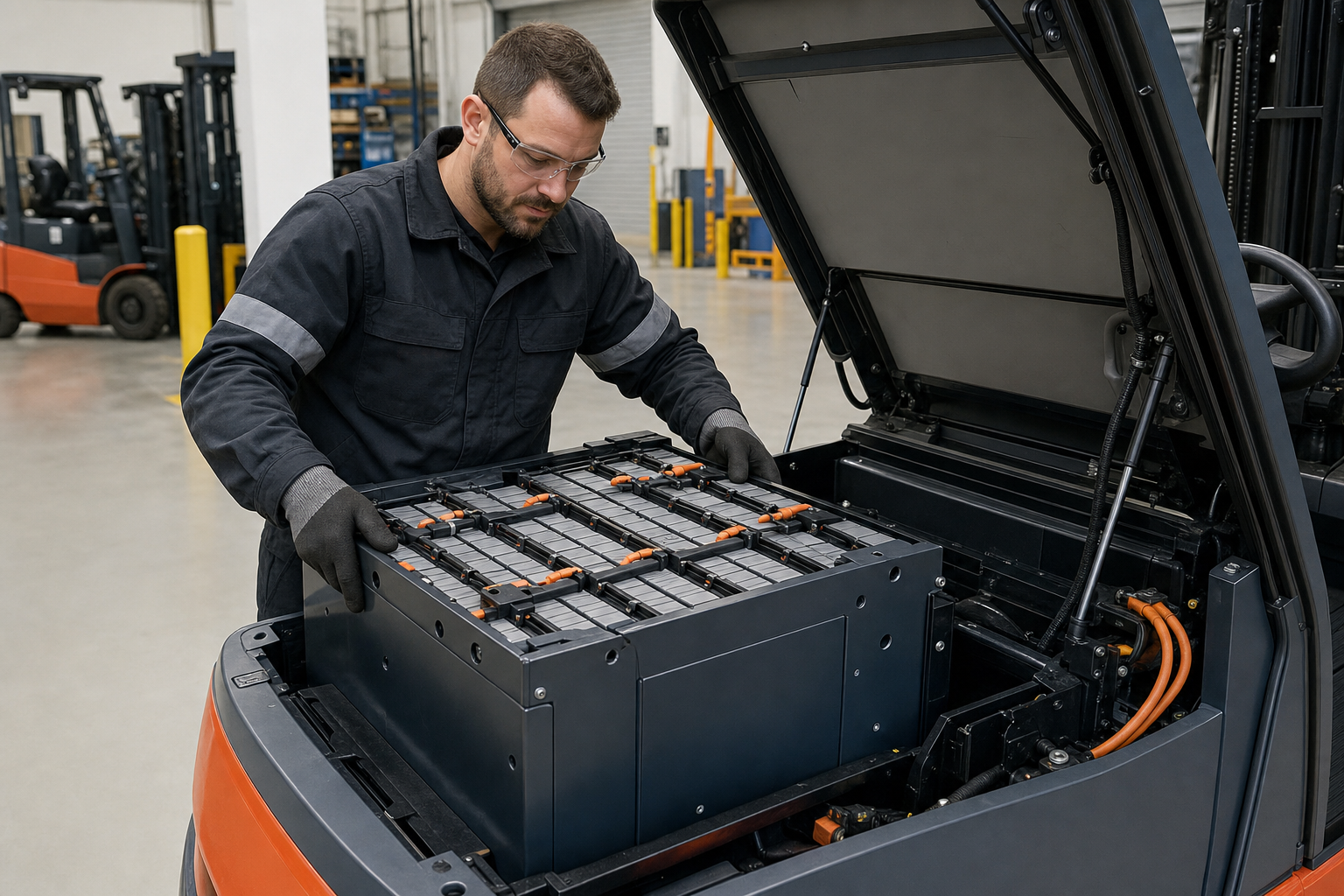
Forklift battery replacement is a decision with direct financial and operational consequences. Choosing the wrong specification can mean unplanned downtime, higher maintenance costs, or even voided equipment warranties. For B2B buyers, the stakes are high: every hour a forklift sits idle waiting for a battery swap is lost productivity that cannot be recovered. This guide explains the technical and commercial factors that determine which battery replacement is right for your fleet, and how to defend your choice to management.
What are the main types of forklift batteries and how do they compare?
Forklift batteries are typically available in two main chemistries: lead-acid and lithium-ion. Lead-acid batteries have been standard for decades, but lithium-ion batteries are increasingly specified for new fleets due to higher cycle life and faster charging. The choice between them affects not only purchase cost but also lifetime operating expenses and maintenance schedules.
Lead-acid batteries generally offer 1,200–1,500 cycles at 80% depth of discharge (DoD), while lithium-ion batteries such as LiFePO4 packs deliver 3,000–4,000 cycles at the same DoD. Lithium-ion batteries also support opportunity charging, reducing the need for battery swaps and dedicated charging rooms. However, the initial cost is higher, and not all forklifts are compatible without modification.
Buyers should compare not just the upfront price, but the cost per cycle. Request supplier quotes for the same voltage and amp-hour rating, then divide the quoted price by the rated cycle life to estimate cost per cycle. This approach makes the long-term cost difference clear.
| Battery Type | Typical Cycle Life (80% DoD) | Maintenance | Charging Time |
|---|---|---|---|
| Lead-Acid | 1,200–1,500 | Weekly watering, equalization | 6–8 hours |
| Lithium-Ion (LiFePO4) | 3,000–4,000 | Minimal | 2–3 hours |
How do I size a replacement battery for my forklift?
Correct sizing of a forklift battery replacement starts with the forklift’s voltage and amp-hour requirements. The battery voltage must match the forklift’s system voltage exactly—common values are 24V, 36V, 48V, and 80V. Installing a battery with the wrong voltage risks damaging both the battery and the forklift’s electrical system.
The amp-hour (Ah) rating determines how long the forklift can operate between charges. Calculate the required Ah by dividing the total daily energy consumption (in kWh) by the battery voltage, then multiplying by a safety factor of 1.2 to account for real-world inefficiencies. For example, a forklift consuming 16 kWh per day at 48V would require at least a 400Ah battery (16,000 Wh / 48V × 1.2 ≈ 400Ah).
Also confirm the physical dimensions and weight. Many forklifts use the battery as counterweight; a lighter lithium-ion battery may require additional ballast. Always check the manufacturer’s specification sheet for minimum and maximum battery weight.
- Match voltage exactly (e.g., 48V system requires 48V battery)
- Calculate amp-hour rating based on daily usage and safety factor
- Check battery compartment dimensions and weight requirements
What are the risks of incorrect forklift battery replacement?
Incorrect forklift battery replacement can cause operational interruptions, equipment damage, and safety hazards. Using a battery with insufficient capacity leads to mid-shift failures, requiring unscheduled swaps and increasing labor costs. Over-specifying capacity adds unnecessary expense and may exceed the forklift’s charging system limits.
Voltage mismatches can trigger controller faults or permanent damage to the forklift’s electronics. Incompatible connectors or battery management system (BMS) protocols may prevent the battery from communicating with the forklift, disabling safety features or charging functions.
Failure to meet the forklift’s minimum battery weight specification can reduce lifting stability, creating a safety risk. Conversely, exceeding the weight limit may cause premature wear on drive components. Each of these risks translates directly into avoidable costs or liability.
How do lithium-ion forklift batteries reduce total cost of ownership?
Lithium-ion forklift batteries reduce total cost of ownership by extending cycle life, minimizing maintenance, and enabling opportunity charging. With 3,000–4,000 cycles at 80% DoD, lithium-ion batteries last two to three times longer than lead-acid under typical warehouse conditions.
Maintenance costs are lower because lithium-ion batteries do not require watering, equalization, or acid spill containment. Charging can be performed during breaks, reducing the need for spare batteries and swap labor. The result is fewer battery purchases over the fleet’s lifetime and lower labor overhead.
However, the higher initial cost must be justified by sufficient utilization. For low-usage forklifts or operations with long idle periods, the payback period may extend beyond the battery’s useful life. Buyers should model their own usage profile and request cost-per-cycle calculations from suppliers.
- Longer cycle life: 3,000–4,000 cycles at 80% DoD
- Lower maintenance: no watering or acid handling
- Faster charging: 2–3 hours, supports opportunity charging
What technical specifications must be confirmed before ordering?
Before ordering a forklift battery replacement, confirm the following technical specifications with both the forklift and battery supplier:
- Voltage (V): Must match forklift system exactly
- Amp-hour rating (Ah): Sufficient for daily usage plus margin
- Physical dimensions: Must fit battery compartment
- Weight: Meets forklift’s minimum and maximum specification
- Connector type: DIN, SB, or custom
- BMS communication: CAN bus, RS485, or analog signals
- Charging compatibility: Confirm with existing chargers
Request a technical drawing or datasheet for both the forklift and the replacement battery. Cross-check connector pinouts and communication protocols. If the forklift uses a battery management system, ensure the replacement battery supports the same protocol, or request integration support from the supplier.
How should buyers compare supplier quotations for forklift battery replacement?
To compare supplier quotations, require each supplier to quote the same voltage, amp-hour rating, and cycle life (at a stated DoD, such as 80%). Then calculate the cost per cycle by dividing the quoted price by the rated cycle count. This normalizes for differences in lifespan and makes the long-term cost transparent.
Also compare warranty terms, aftersales support, and lead time. A lower upfront price may be offset by shorter warranty coverage or limited technical support. Ask for references from similar industrial customers and request documentation of previous installations.
For international procurement, clarify Incoterms, shipping method, and customs documentation. Delays in customs clearance or missing paperwork can halt operations and incur demurrage charges.
| Factor | What to Request |
|---|---|
| Specification | Same voltage, Ah, cycle life (e.g., 48V 400Ah, 4,000 cycles @ 80% DoD) |
| Warranty | Coverage period and cycle count |
| Aftersales Support | Response time, onsite service availability |
| References | Similar installations, documented case studies |
What installation and commissioning steps are required?
Installation of a forklift battery replacement requires careful handling and technical checks. Always use lifting equipment rated for the battery’s weight. Inspect the battery for shipping damage and verify the serial number against the delivery note.
Before connecting, confirm polarity and connector compatibility. For lithium-ion batteries, check that the BMS is powered and communicating with the forklift. Some forklifts require a software update or parameter adjustment to recognize a new battery type.
After installation, perform a full charge-discharge cycle under supervision. Monitor voltage, current, and temperature during operation. Record initial performance data for warranty and maintenance tracking.
- Use rated lifting equipment
- Verify connector and polarity
- Check BMS communication
- Monitor first charge-discharge cycle
How do maintenance requirements differ between battery types?
Lead-acid batteries require weekly watering, periodic equalization charging, and regular cleaning to prevent acid buildup. Failure to maintain electrolyte levels can reduce cycle life by 30–40%. Acid spills must be contained and neutralized according to local regulations.
Lithium-ion batteries require almost no routine maintenance. Periodic inspection for physical damage and BMS error logs is sufficient. Most lithium packs include onboard diagnostics that alert operators to abnormal conditions.
Maintenance labor and downtime should be factored into total cost of ownership. For multi-shift operations, the reduction in maintenance hours with lithium-ion batteries can be significant over a five-year period.
What are the key safety and compliance considerations?
Forklift battery replacement must comply with local electrical safety codes and, for lithium-ion batteries, relevant transport regulations such as UN38.3. Installation should be performed by trained personnel using insulated tools and personal protective equipment.
For lithium-ion batteries, confirm that the supplier provides documentation for safe transport and storage. Some jurisdictions require fire suppression systems for battery charging areas. Always check with local authorities for specific compliance requirements.
Battery disposal and recycling must follow environmental regulations. Lead-acid batteries are widely recycled, while lithium-ion battery recycling infrastructure varies by region. Request end-of-life documentation from the supplier.
- Comply with local electrical and fire codes
- Request UN38.3 transport documentation for lithium batteries
- Plan for end-of-life recycling or disposal
How can buyers ensure long-term reliability and support?
Long-term reliability depends on supplier stability, technical support, and spare parts availability. Choose suppliers with documented installations in similar environments and a track record of aftersales service. For international buyers, confirm local support arrangements or remote diagnostics capability.
Request a preventive maintenance plan and recommended spare parts list. For lithium-ion batteries, ensure firmware updates and BMS diagnostics are available for the expected service life. Document all installation and maintenance actions for warranty claims.
Buyers should periodically review battery performance data and schedule capacity tests every 12–18 months. Early detection of degradation allows for planned replacement, reducing the risk of unplanned downtime.
What is the next step for B2B buyers considering forklift battery replacement?
The next step is to gather forklift model specifications, daily usage data, and current battery details. Request technical datasheets and quotations from suppliers for batteries matching your fleet’s voltage, amp-hour, and cycle life requirements. Compare cost per cycle, warranty, and aftersales support before making a decision. For complex fleets or mixed chemistries, consider a technical assessment to confirm compatibility and integration requirements.
Frequently asked questions
How do I confirm if a lithium-ion battery is compatible with my forklift?
Check the forklift’s voltage, connector type, and battery management system communication protocol. Request a technical datasheet from both the forklift and battery supplier, and confirm compatibility before ordering.
What is the typical payback period for switching from lead-acid to lithium-ion forklift batteries?
The payback period depends on usage intensity. In multi-shift operations, lithium-ion batteries may pay back in 2–4 years due to reduced maintenance and longer cycle life. For low-usage fleets, the payback may be longer.
What documentation should I request from a battery supplier for international shipments?
Request a detailed technical datasheet, UN38.3 transport certification for lithium batteries, warranty terms, and a packing list with serial numbers. Confirm Incoterms and customs paperwork to avoid shipment delays.
AJPOWER-Battery