
I’ve been in the battery manufacturing business for over a decade, and if there’s one conversation I have more than any other with procurement managers across Europe, it’s this one: “We’ve always used lead-acid. Why should we change?”
It’s a fair question. Lead-acid batteries have been around for over 150 years. They’re familiar, they’re cheap upfront, and every engineer on your team already knows how to handle them. I get it.
But here’s what I’ve seen happen — repeatedly — to businesses that stick with lead-acid out of habit rather than logic: they spend more, replace more, and deal with more downtime than they ever budgeted for.
Let me walk you through what we actually see on the ground.
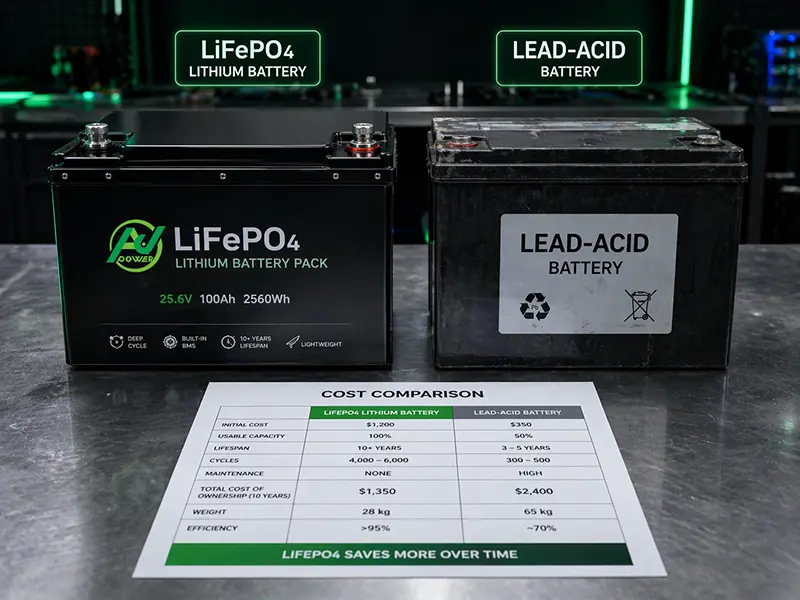
When a procurement manager tells me lead-acid is cheaper, I always ask the same question: cheaper over what timeframe?
A quality LiFePO4 battery pack delivers 4,000 or more charge cycles. A lead-acid unit typically manages 300 to 500 before performance degrades to the point of replacement. Do that math against your application’s daily cycling pattern, and the total cost of ownership picture changes completely.
We supply stairlift manufacturers in the UK, AGV operators in Germany, and security infrastructure companies across the Middle East. Almost every single one of them came to us after a bad experience with lead-acid — not because the batteries failed dramatically, but because they quietly underperformed. Shorter backup windows. More frequent replacements. Maintenance calls that were never budgeted.
That’s the hidden cost nobody puts in the initial procurement spreadsheet.

One thing I want to address directly, because I hear a lot of confusion about this: switching to LiFePO4 does not always mean redesigning your system from scratch.
For standard 12V and 24V applications — which covers a significant portion of UPS systems, emergency lighting, and mobility equipment — our LiFePO4 packs are designed as direct replacements. Same voltage profile, same form factor, no system redesign required.
Where it gets more complex is in applications with specific discharge rate requirements, temperature extremes, or custom housing constraints. That’s where our engineering team gets involved early in the conversation — before the purchase order, not after.
This is something I feel strongly about. A battery supplier should be a technical partner, not just a box shipper. If your supplier can’t discuss BMS configuration, thermal management, or cycle life projections for your specific application, that’s a red flag worth paying attention to.
After years of working with B2B buyers across different industries, I’ve noticed that the companies with the smoothest procurement processes tend to ask better questions upfront. Here’s what I’d recommend:
1. Does this battery meet the compliance requirements for my end market? CE, UKCA, UN38.3, IEC 62133 — these aren’t optional extras. They’re market access requirements. If your supplier can’t provide full certification documentation, you’re carrying that regulatory risk yourself.
2. What happens at volume? Sample quality is easy. Consistent quality across production batches at scale is what separates serious manufacturers from trading companies. Ask about ISO 9001 certification and what their in-line quality control process looks like.
3. What’s the support structure after delivery? Technical issues in battery applications rarely surface immediately. They show up three months into deployment, often in a customer’s product rather than a test environment. Knowing your supplier has responsive technical support isn’t a nice-to-have — it’s a supply chain risk management issue.
Honestly? Medical mobility and UAV applications are the two areas where I think procurement teams are most underserved by the current market.
Stairlift and wheelchair manufacturers need batteries that combine high reliability with strict safety compliance — and the margin for error is essentially zero when you’re talking about equipment that elderly or disabled users depend on daily. Most of the suppliers in this space are either consumer-grade manufacturers who don’t understand the compliance requirements, or industrial suppliers whose packs are simply too large and heavy for the application.
On the UAV side, the performance demands are entirely different — high C-rate discharge, weight sensitivity, thermal management under load — but the procurement challenge is similar. Too many buyers are sourcing from suppliers who don’t specialise in the application, and discovering the mismatch only after deployment.
These are problems that better supplier selection solves. Not more expensive technology — just the right partner with the right expertise.
If you’re evaluating a new battery supplier for the first time, request samples before committing to a production order. Any reputable manufacturer should support this without hesitation.
When you receive the samples, test them against your actual application conditions — not lab conditions. Real operating temperatures. Real discharge cycles. Real mechanical environment. The difference between how a battery performs in a controlled test and how it performs in your product is where procurement decisions are won or lost.
At AJ Power, we encourage this. We’d rather spend time upfront getting the specification right than deal with a performance issue six months into a supply relationship.
The battery inside your product is not a commodity purchase. It affects your product’s reliability, your brand’s reputation, and your customer’s experience — every single day.
The procurement managers I respect most are the ones who treat battery sourcing the way they treat any other critical component: with rigorous evaluation, clear technical requirements, and a long-term partnership mindset.
If you’re currently reviewing your battery supply chain or evaluating alternatives to your existing supplier, I’m always happy to have a direct conversation. No sales pitch — just an honest technical discussion about whether we’re the right fit for what you’re building.
Linda Chen Managing Director, AJ Power Co. Ltd.
AJ Power specialises in custom LiFePO4, Li-ion, Li-Po, and Ni-MH battery solutions for industrial, medical, UAV, AGV, and security applications. CE, UKCA, UN38.3, IEC 62133, ISO 9001 certified.

AJPOWER-Battery